Laisser un message
Si vous êtes intéressé par nos produits et souhaitez en savoir plus, veuillez laisser un message ici, nous vous répondrons dès que possible.

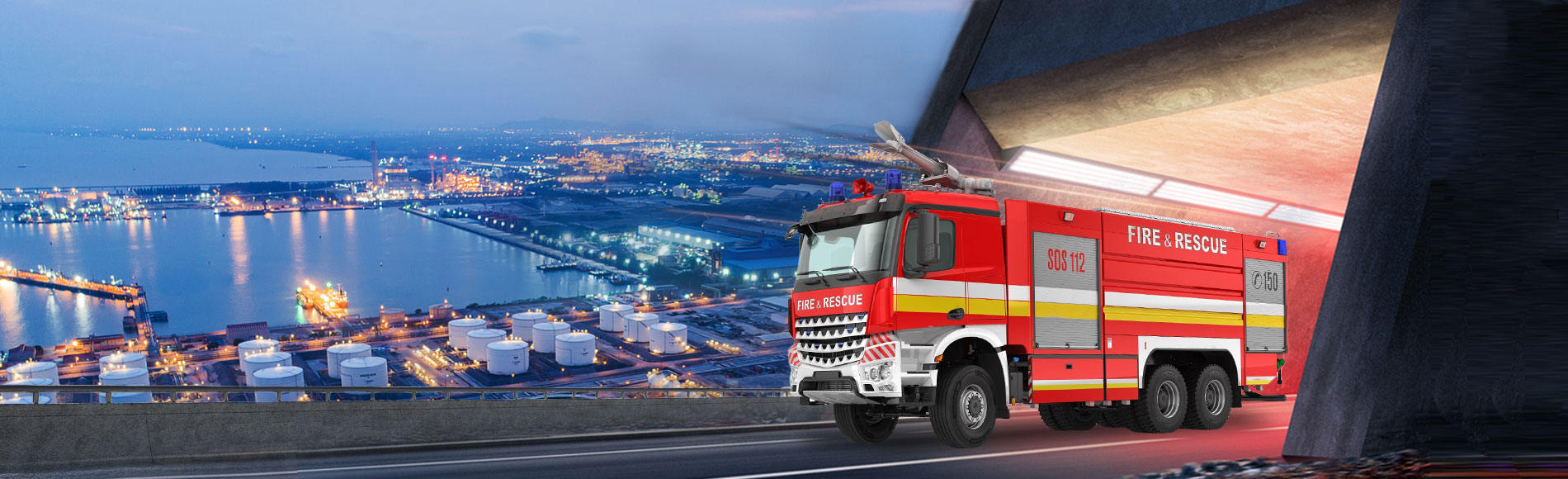
Capacité du réservoir d'eau d'un camion de pompiers : quelle quantité d'eau les camions de pompiers contiennent-ils ?
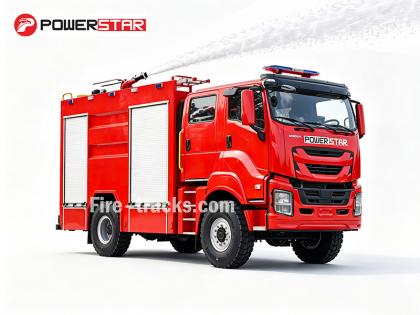
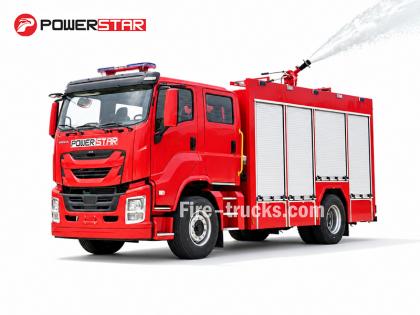
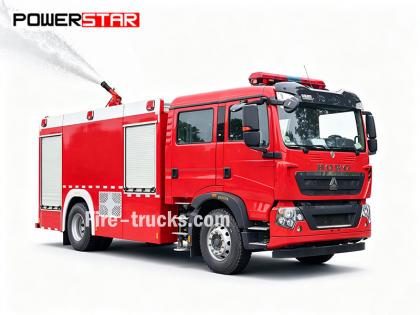
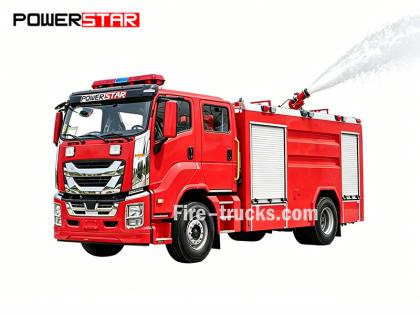
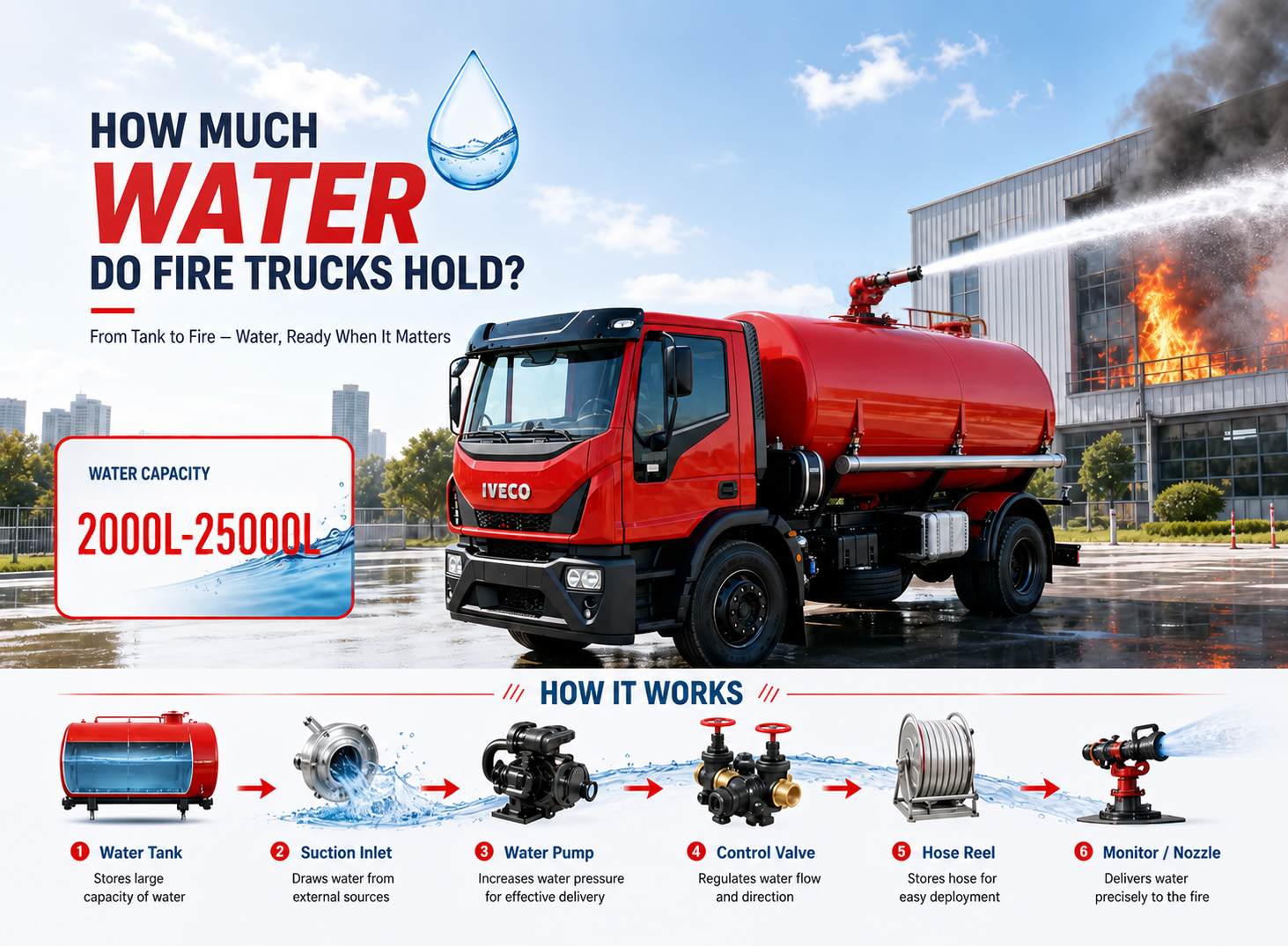
Quelle quantité d’eau un camion de pompiers peut-il transporter ? C’est l’une des premières questions auxquelles nos clients sont confrontés lorsqu’ils choisissent un camion de pompiers. Il n’existe pas de nombre fixe unique : cela dépend du type de véhicule, de la capacité du châssis, de la conception prévue et des réglementations régionales, allant des unités légères de 2 000 litres aux camions de pompiers industriels de 25 000 litres. Cependant, un réservoir plus grand ne signifie pas toujours de meilleures performances ;véhicule de lutte contre l’incendie la capacité du réservoir d’eau doit être correctement adaptée au débit de la pompe, au débit de décharge du canon et à la capacité du châssis afin d’obtenir des résultats efficaces de lutte contre l’incendie.
Cet article commence par les principes fondamentaux de la capacité des réservoirs d’eau des camions de pompiers, analyse les plages de stockage typiques pour différents types de véhicules, examine les principaux facteurs qui influencent la conception des réservoirs et fournit des conseils pratiques pour l’achat.
Points clés à retenir :
La capacité du réservoir d’eau d’un camion de pompiers varie généralement de 2 000 à 25 000 litres
Les différents types de camions de pompiers ont des capacités de réservoir différentes
Un réservoir plus grand ne signifie pas une meilleure capacité de lutte contre l’incendie
La capacité du réservoir doit être adaptée au débit de la pompe, au débit du canon et à la capacité du châssis
La lutte contre les incendies industriels nécessite généralement de grands réservoirs, tandis que la lutte contre les incendies municipaux privilégie la maniabilité
Camions d’intervention avec pompe :Ce sont les camions de pompiers municipaux les plus courants. Ils dépendent principalement des bornes d’incendie pour l’approvisionnement en eau et transportent environ 1 900 à 3 800 litres d’eau embarquée pour l’attaque initiale. Le cœur de ces véhicules est la pompe, et non le réservoir : ils sont conçus pour fournir de l’eau sous pression une fois raccordés à une borne d’incendie.
Camions-citernes (ravitailleurs en eau) :Ces véhicules sont dédiés au transport de grands volumes d’eau, avec des capacités de réservoir dépassant généralement 11 400 litres. Ils jouent un rôle essentiel dans les zones rurales et isolées où les bornes d’incendie ne sont pas disponibles, en transportant l’eau des sources d’approvisionnement jusqu’au lieu de l’incendie pour que les camions-pompes puissent l’utiliser.
Camions pompe-citerne :Ces véhicules combinent les fonctions de pompage et de transport d’eau en une seule unité. Ils peuvent à la fois projeter de l’eau pour la lutte contre l’incendie et approvisionner d’autres véhicules. Les capacités de réservoir varient généralement de 5 700 à 11 400 litres, ce qui en fait une solution polyvalente pour les services d’incendie.
| Type de camion de pompiers | Capacité typique du réservoir | Application principale |
|---|---|---|
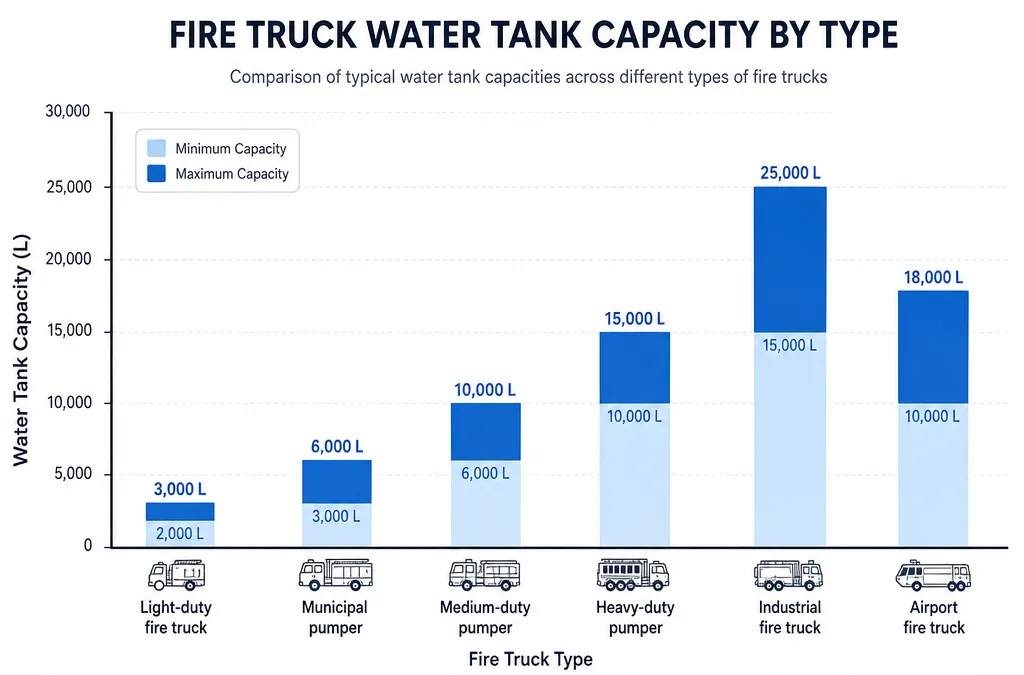
| Camion de pompiers léger | 2 000–3 000 L | Intervention rapide en zone urbaine, attaque initiale |
| Camion-pompe municipal | 3 000–6 000 L | Lutte contre les incendies municipaux, incendies de structures |
| Camion-pompe moyen | 6 000–10 000 L | Tâches urbaines et industrielles combinées |
| Camion-pompe lourd | 10 000–15 000 L | Opérations prolongées, intervention à longue distance |
| Camion de pompiers industriel | 15 000–25 000 L | Lutte contre les incendies dans les secteurs pétrolier, chimique et minier |
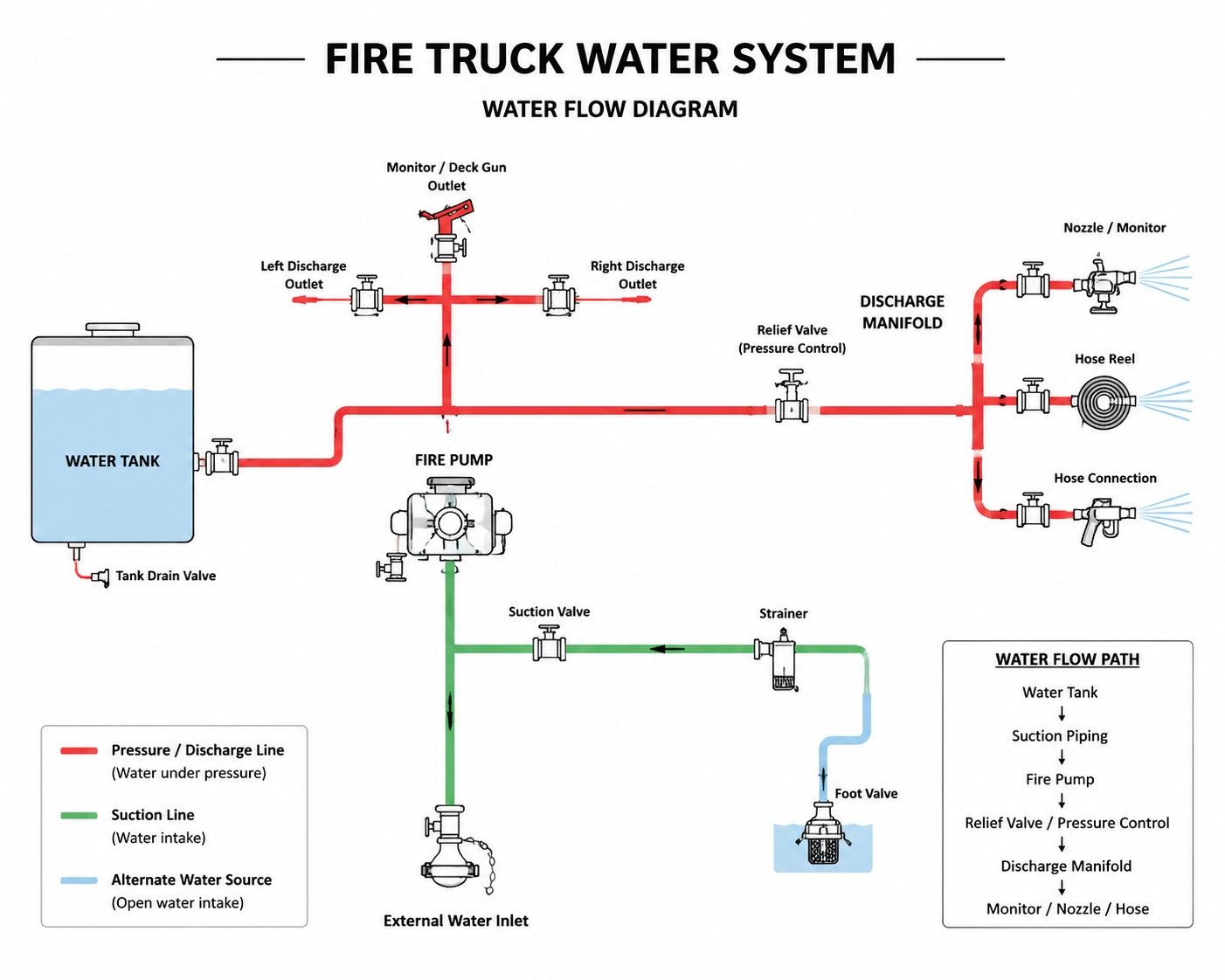
Un camion de pompiers n’est pas seulement un réservoir d’eau mobile : c’est un système complet d’acheminement de l’eau. L’eau stockée dans le réservoir doit traverser plusieurs composants essentiels avant de pouvoir atteindre l’incendie. Le parcours complet du flux est le suivant :
Réservoir d’eau → Tuyauterie d’aspiration → Pompe incendie → Système de contrôle de pression → Collecteur de décharge → Canon incendie/Buse/Tuyau
Réservoir d’eau
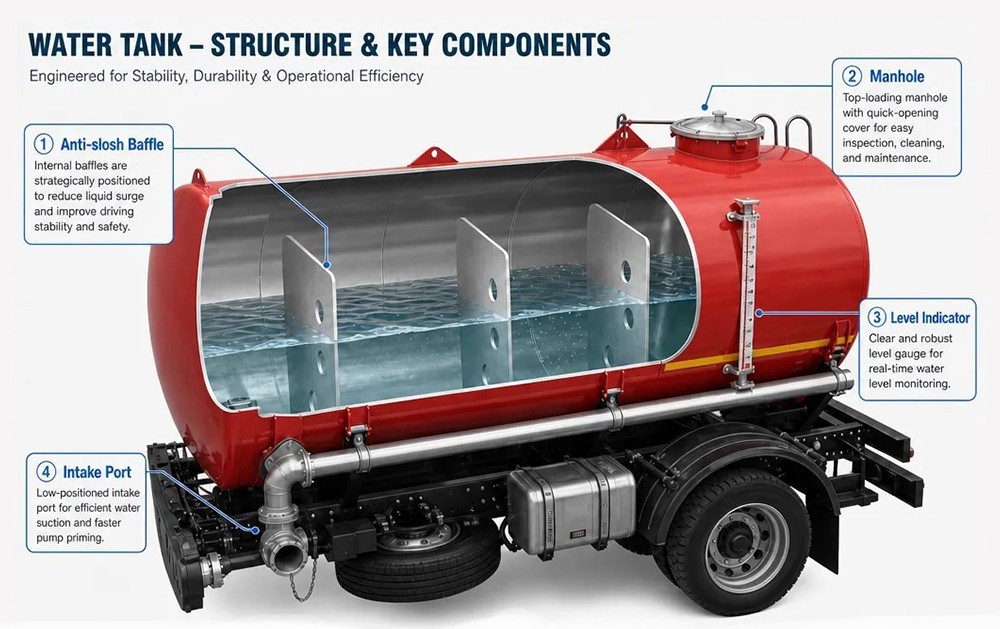
Le réservoir d’eau est le conteneur de stockage principal. Sa conception influence directement le volume d’eau utilisable et la durée de service.
Cloisons anti-ballottement :Partitions internes qui empêchent les mouvements brusques de l’eau pendant la conduite et les virages serrés, maintenant ainsi la stabilité du véhicule.
Matériaux résistants à la corrosion :Les réservoirs sont généralement fabriqués en acier inoxydable 304 ou en acier au carbone revêtu afin de résister à la corrosion prolongée par l’eau.
Trou d’homme :Point d’accès situé sur le dessus du réservoir pour l’inspection interne, le nettoyage et la maintenance.
Indicateur de niveau :Affiche la quantité d’eau restante en temps réel, aidant les opérateurs à planifier les stratégies de lutte contre l’incendie.
Tuyauterie d’aspiration
La tuyauterie d’aspiration achemine l’eau du réservoir vers la pompe incendie. Elle possède généralement un grand diamètre afin de réduire la résistance à l’écoulement, est équipée d’un clapet anti-retour pour empêcher le reflux et dispose d’un filtre pour empêcher les débris de pénétrer dans la pompe.
Pompe incendie
La pompe incendie est le cœur énergétique du système d’eau. Elle est chargée de :
Créer une pression d’eau suffisante pour surmonter la résistance des conduites et l’élévation verticale
Augmenter le débit afin de répondre aux besoins de la lutte contre l’incendie
Fournir une alimentation en eau continue pour des opérations prolongées
Système de refoulement
L’eau sous pression est acheminée par le collecteur de refoulement vers différents dispositifs de distribution, notamment les canons à incendie (lutte contre l’incendie à distance avec un grand volume d’eau), les lances manuelles (lutte contre l’incendie de précision), les dévidoirs de tuyaux haute pression (pour les incendies localisés ou une intervention rapide) et plusieurs sorties de refoulement (raccordements simultanés de tuyaux).
Beaucoup supposent qu’un réservoir de 10 000 litres peut évacuer 10 000 litres d’eau. En réalité, le volume d’eau utilisable est généralement inférieur à la capacité nominale du réservoir. Les principales raisons sont :
1. Restriction liée à la hauteur de l’entrée d’aspiration
L’entrée d’aspiration de la pompe incendie est généralement positionnée à une certaine hauteur au-dessus du fond du réservoir d’eau, plutôt que d’être au niveau du plancher du réservoir. Cette conception vise à empêcher l’aspiration des sédiments et des impuretés déposés au fond. Cependant, cela signifie qu’environ 5 % à 10 % de l’eau située tout en bas ne peut pas être aspirée et utilisée par la pompe.
2. Prévention de l’entrée d’air dans la pompe incendie
L’entrée d’aspiration doit rester entièrement immergée en permanence afin d’empêcher l’air d’être aspiré dans le corps de la pompe. Une fois que de l’air est aspiré, cela peut provoquer un fonctionnement à sec de la pompe, entraîner une cavitation (lorsque la roue tourne dans un mélange de bulles d’air et d’eau, et que l’effondrement des bulles génère des ondes de choc qui endommagent la roue) et provoquer une chute soudaine de pression. Dans les cas graves, cela peut endommager ou même détruire la pompe incendie.
3. Effet des cloisons à l’intérieur du réservoir
Les cloisons divisent le réservoir en plusieurs compartiments. Bien qu’elles réduisent efficacement le ballottement de l’eau pendant les déplacements du véhicule, les orifices d’écoulement situés au fond de ces compartiments sont relativement petits. Lorsque le niveau d’eau est bas, le débit d’eau est limité, empêchant une partie de l’eau d’atteindre rapidement la zone de la conduite d’aspiration.
| Capacité nominale | Capacité utilisable | Taux de perte |
|---|---|---|
| 5 000 L | Environ 4 500–4 700 L | 6 %–10 % |
| 10 000 L | Environ 9 000–9 400 L | 6 %–10 % |
| 15 000 L | Environ 13 500–14 100 L | 6 %–10 % |
Principe d’adaptation :Si le débit de la pompe est trop élevé, le réservoir sera épuisé en quelques minutes. Si le débit est trop faible, la grande capacité du réservoir ne pourra pas être pleinement utilisée. Une recommandation générale est que la durée de décharge continue au débit nominal ne soit pas inférieure à 5–10 minutes.
| Capacité du réservoir | Débit de pompe recommandé | Application recommandée |
|---|---|---|
| 2 000 L | 30 L/s | Petits camions de pompiers, lutte contre l'incendie communautaire |
| 3 000–5 000 L | 40 L/s | Lutte contre l'incendie municipale, attaque initiale |
| 6 000–8 000 L | 60 L/s | Lutte contre l'incendie municipale, incendies de structures |
| 10 000–15 000 L | 80 L/s | Lutte contre l'incendie industrielle, opérations prolongées |
| 15 000 L et plus | 100 L/s et plus | Pétrochimie, lutte contre l'incendie dans les aéroports |
1. Capacité de charge du châssis
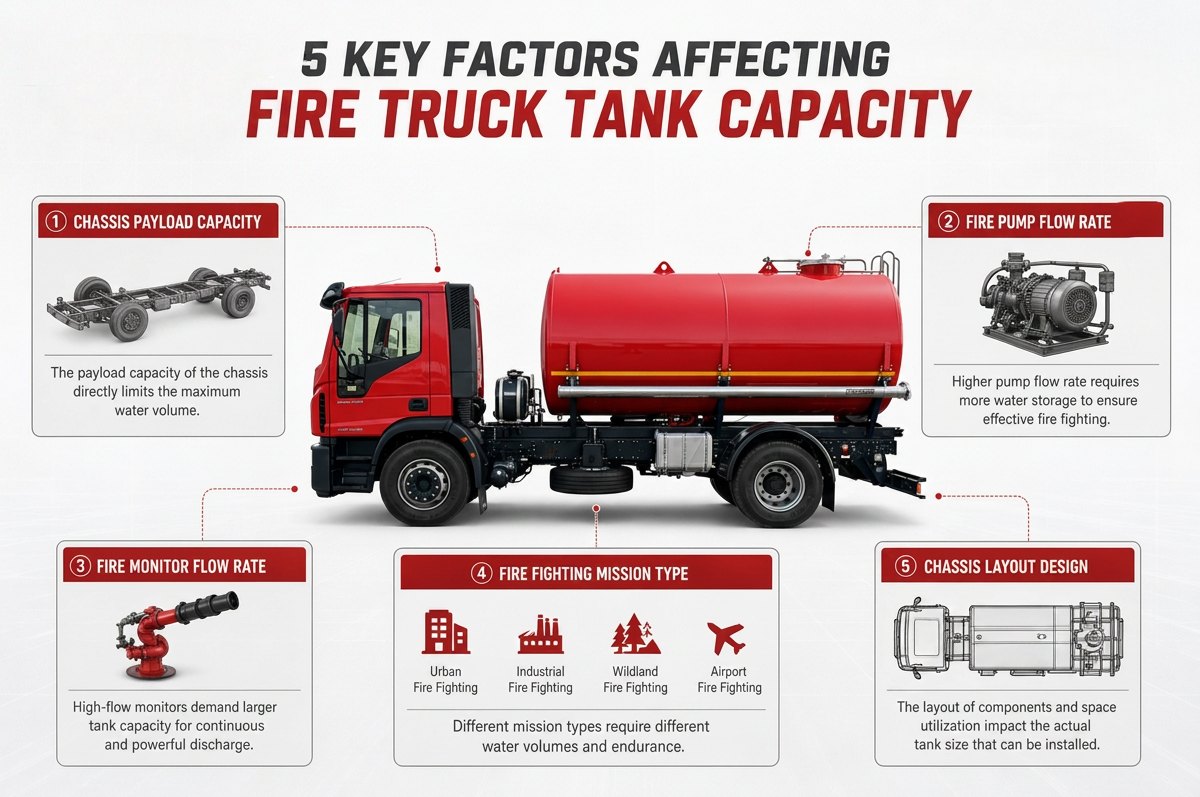
La capacité du réservoir d'eau est principalement limitée par le poids total autorisé en charge (PTAC) du véhicule. Les châssis courants de camions de pompiers comprennent les configurations de transmission 4×2, 6×4 et 8×4. Plus l'empattement est long et plus le nombre d'essieux est élevé, plus la capacité de charge totale est importante. Par exemple, un châssis 6×4 peut généralement accueillir un réservoir d'eau plus grand qu'un châssis 4×2. En outre, la position d'installation du réservoir d'eau doit tenir compte de la répartition de la charge sur les essieux avant et arrière afin de garantir la stabilité et la maniabilité du véhicule dans des conditions de pleine charge comme à vide.
2. Débit de la pompe d'incendie
Une correspondance raisonnable entre le débit de la pompe d'incendie et la capacité du réservoir d'eau est essentielle. Pour une pompe avec un débit de 30 L/s, un réservoir de 10 000 litres peut être vidé en environ 5,5 minutes ; tandis qu'une pompe de 60 L/s le viderait en moins de 3 minutes. Plus le débit de la pompe est élevé, plus le réservoir d'eau se vide rapidement. Par conséquent, lors de la sélection des spécifications, une pompe à haut débit doit être associée à un réservoir plus grand afin de garantir une durée de fonctionnement continu suffisante. À l'inverse, associer une pompe à faible débit à un réservoir surdimensionné entraîne un gaspillage de charge utile du véhicule et une augmentation des coûts.
3. Débit du canon à eau
Les canons à eau sont de grands consommateurs d'eau. Les grands canons peuvent avoir des débits de 48–100 L/s ou plus. Un canon à haut débit peut épuiser un réservoir d'eau entier en quelques minutes. Par conséquent, les camions de pompiers équipés de canons à haut débit doivent soit être dotés de réservoirs de capacité correspondante, soit pouvoir se raccorder rapidement à une source d'eau externe.
4. Type de mission de lutte contre l'incendie
Les différents types d'incendies imposent des exigences variables en matière de capacité du réservoir d'eau. Pour les incendies urbains de structures, les pompiers peuvent généralement se raccorder aux bouches d'incendie dans un délai de 3–5 minutes ; le réservoir embarqué est donc principalement utilisé pour l'extinction initiale, et l'exigence de capacité est relativement modérée. Pour les incendies industriels, le lieu de l'incendie est souvent éloigné des bouches d'incendie et les opérations de lutte durent plus longtemps, ce qui nécessite de grands réservoirs d'une capacité supérieure à 10 000 litres. Pour les feux de forêt, les camions de pompiers doivent parcourir de longues distances et maintenir une projection d'eau continue, ce qui rend essentielles à la fois la capacité et l'autonomie.
5. Agencement du châssis
La disposition du réservoir d'eau, du réservoir de mousse et des compartiments d'équipement sur le châssis affecte directement la capacité maximale de réservoir pouvant être installée. L'emplacement du moteur détermine l'espace disponible ; l'ajout de réservoirs de mousse occupe une partie du volume ; et le nombre ainsi que la taille des compartiments d'équipement influencent également directement la capacité finale du réservoir.
1. Quelle quantité d'eau un camion de pompiers peut-il généralement transporter ?
La plupart des camions de pompiers municipaux transportent 3 000–10 000 litres. Les grands camions de pompiers industriels peuvent atteindre 15 000–25 000 litres, tandis que les mini-camions de pompiers transportent généralement 500–1 500 litres, selon le type de véhicule et son utilisation.
2. Quel type de camion de pompiers possède la plus grande capacité de réservoir ?
Les grands camions de pompiers industriels et les camions de pompiers d'aéroport possèdent généralement les plus grands réservoirs, certains modèles dépassant 20 000 litres.
3. Un plus grand réservoir est-il toujours préférable ?
Pas nécessairement. La capacité du réservoir doit être adaptée à la capacité du châssis, aux performances de la pompe et aux exigences réelles d'utilisation. Chercher uniquement à augmenter la taille du réservoir peut entraîner une réduction de la maniabilité et des coûts plus élevés.
4. Quel est le poids d'un camion de pompiers entièrement chargé ?
Cela dépend du type de véhicule et de la capacité du réservoir. 10 000 litres d'eau pèsent environ 10 tonnes. Avec le poids à vide du véhicule (généralement 10–15 tonnes), le poids total en charge peut atteindre 20–25 tonnes, ce qui nécessite un châssis adapté.
5. Un camion de pompiers peut-il se ravitailler en eau pendant la lutte contre un incendie ?
Oui. Les camions de pompiers peuvent être réapprovisionnés en continu à partir des bornes d'incendie, des sources d'eau naturelles ou des camions-citernes d'eau, ce qui permet de maintenir des opérations de lutte contre l'incendie prolongées.
6. Un camion de pompiers à mousse possède-t-il un réservoir d'eau plus petit qu'un camion-citerne d'eau ?
Généralement, oui. Les camions de pompiers à mousse doivent réserver de l'espace pour un réservoir de mousse en plus du réservoir d'eau, de sorte que la capacité du réservoir d'eau est généralement réduite dans les mêmes conditions de châssis.
7. Comment déterminer la capacité de réservoir adaptée à mon projet ?
Tenez compte du type d'incendie, des conditions d'approvisionnement en eau, du débit de la pompe, de la capacité du châssis et des exigences du projet. Choisissez la capacité qui correspond le mieux à vos besoins plutôt que de rechercher simplement le plus grand réservoir disponible.
La capacité du réservoir d'eau d'un camion de pompiers varie généralement de 2 000 à 25 000 litres, avec des capacités différentes adaptées à différents scénarios d'exploitation. La lutte contre les incendies municipaux privilégie la maniabilité — 3 000 à 6 000 litres suffisent pour une première intervention, avec un approvisionnement continu assuré par les bornes d'incendie. La lutte contre les incendies industriels et d'aéroport nécessite 15 000 litres ou plus pour les opérations à longue distance et prolongées. La lutte contre les incendies de végétation nécessite un équilibre entre capacité et aptitude tout-terrain, avec 6 000 à 10 000 litres constituant une configuration courante.
Lors du choix d'un camion de pompiers, la capacité du réservoir n'est qu'un facteur parmi d'autres. Elle doit être correctement associée au débit de la pompe, à la configuration du canon, à la capacité du châssis et aux exigences opérationnelles afin de fournir des performances efficaces de lutte contre l'incendie.


Vous pouvez être intéressé par les informations suivantes
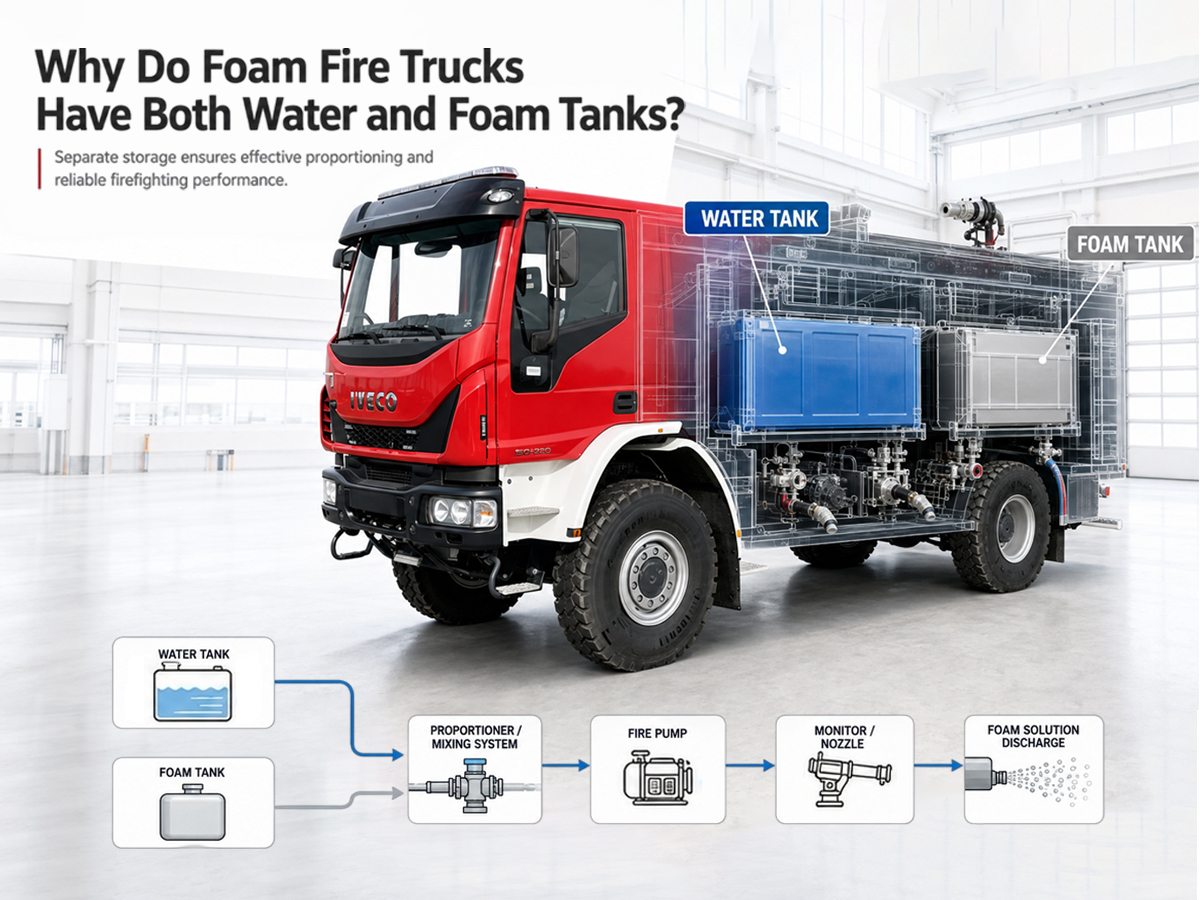
Les camions de pompiers à mousse combinent un réservoir dédié au concentré de mousse avec un réservoir d'eau séparé et un système de dosage précis. Ils utilisent un système de dosage pour introduire le concentré de mousse dans le jet d'eau à une concentration spécifiée, généralement 1 %, 3 % ou 6 %, en fonction du concentré de mousse et de l'application de lutte contre l'incendie.double réservoirLa conception permet aux pompiers d'utiliser uniquement de l'eau lorsque la mousse n'est pas nécessaire et d'introduire du concentré de mousse uniquement en cas de besoin. Cela améliore la flexibilité opérationnelle, contribue à maîtriser la consommation de mousse et permet de configurer le système d'extinction en fonction des différents risques d'incendie. Le principe de fonctionnement et la technologie clé des camions de pompiers à mousse, notamment la présence de réservoirs d'eau et de mousse, suscitent l'intérêt de nombreux clients. Découvrons-le ensemble. Réponse rapide : Les camions de pompiers à mousse utilisent généralement des réservoirs séparés pour l'eau et le concentré de mousse, car ces deux liquides sont nécessaires en proportions différentes et sont destinés à être mélangés pendant l'intervention plutôt que stockés sous forme de solution prémélangée pendant de longues périodes. Le réservoir d'eau fournit l'approvisionnement principal en eau, tandis que le réservoir de mousse stocke l'agent moussant concentré. Un système de dosage contrôle la quantité de concentré injectée dans le jet d'eau, permettant ainsi au camion de passer du mode d'extinction à l'eau seule au mode à la mousse. JE. Quels sont les principaux composants d'un camion de pompiers à mousse ? 1. Réservoir d'eau Construction résistante à la corrosion (acier au carbone avec revêtement anticorrosion ou acier inoxydable), capacités de 4 000 à 6 000 litres. Équipé de chicanes pour réduire les à-coups de liquide lors du déplacement du véhicule et de supports flexibles pour absorber les mouvements du châssis sur terrain accidenté. 2. Réservoir de concentré de mousse Construction en acier inoxydable pour résister aux attaques chimiques des concentrés de mousse active, capacité typique de 500 à 2 000 litres. Selon le type de concentré de mousse et la conception du système, le réservoir peut intégrer des dispositifs tels que des systèmes de circulation ou d'agitation pour aider à maintenir l'état du concentré pendant le stockage. 3. Système de dosage de mousse Un système de dosage qui prélève le concentré de mousse à partir du réservoir dédié.mousseLe concentré de mousse est stocké dans un réservoir et introduit dans le flux d'eau à une concentration spécifiée. Selon le type de concentré et la conception du système, le dosage peut être réalisé par pression équilibrée, par pompe ou par effet Venturi. 4. Pompe à incendie La pompe à incendie est la source d'énergie de l'ensemble du système de mousse. Elle aspire l'eau du réservoir et la pressurise au débit et à la pression requ...
Détails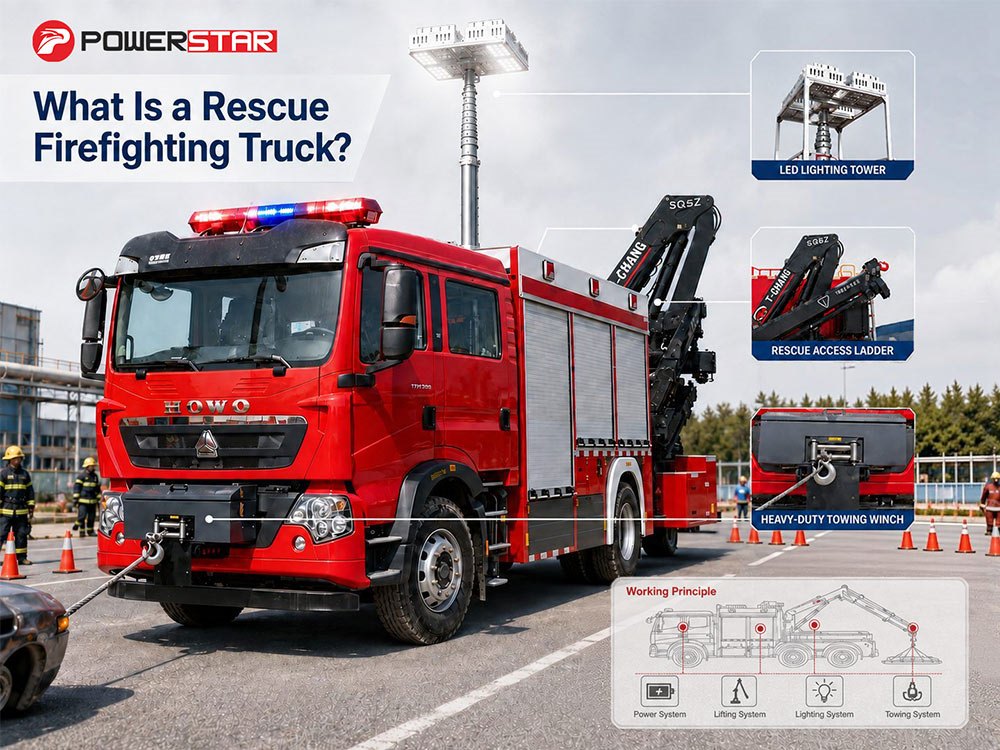
Un camion de pompiers de secours est un véhicule d'urgence spécialisé conçu pour effectuer à la fois des opérations de lutte contre les incendies et de sauvetage. Contrairement aux camions de pompiers classiques qui se concentrent principalement sur l'extinction des incendies,camions de pompiers de secourscombiner l'équipement de lutte contre l'incendie avec des outils de sauvetage, des appareils de levage et de hissage, des outils de coupe et d'épandage, des treuils, des générateurs et des systèmes d'éclairage. Cet article explique ce qu'est un camion de pompiers de secours, en quoi il diffère des autres véhicules d'incendie, quel équipement il transporte et quand il est déployé. I. Qu'est-ce qu'un camion de pompiers de secours ? Un camion de sauvetage et de lutte contre les incendies est un véhicule d'urgence polyvalent qui combine des capacités de lutte contre les incendies et un équipement de sauvetage spécialisé. Il est principalement utilisé pour assurer une capacité d'intervention d'urgence complète lors d'incidents impliquant des personnes, des véhicules, des bâtiments ou des installations industrielles. Selon leur configuration, les camions de secours incendie peuvent être équipés d'une grande variété d'outils de sauvetage et de systèmes d'extinction. Le choix de l'équipement dépend de l'utilisation prévue du véhicule. Par exemple, un véhicule configuré pour le sauvetage en milieu urbain peut avoir un agencement d'équipement différent de celui d'un véhicule conçu pour le sauvetage industriel, les interventions après un séisme ou le dépannage suite à un accident de la route. II. Quel équipement transporte un camion de pompiers de secours ? L'équipement embarqué sur un camion de pompiers de secours dépend de la conception du véhicule et de son utilisation prévue. Cependant, sur la plupart des modèles, il peut être classé en plusieurs catégories principales : matériel de lutte contre l'incendie, outils de sauvetage, matériel électrique, matériel d'éclairage, dispositifs de levage et de remorquage, et équipements de protection individuelle. 1. Équipement de lutte contre l'incendie Le matériel de lutte contre l'incendie peut comprendre des extincteurs, des tuyaux d'incendie, des lances à incendie, des pompes portables, des réservoirs d'eau, des systèmes d'extinction d'incendie à mousse, des canons à incendie et d'autres outils de suppression. 2. Outils de sauvetage hydrauliques Les outils de désincarcération hydrauliques sont couramment utilisés lors des opérations de secours en cas d'accident de la route pour découper, écarter ou soulever les structures endommagées des véhicules. Parmi les équipements courants, on trouve les pinces coupantes hydrauliques, les écarteurs hydrauliques et les vérins hydrauliques. 3. Générateur électrique Les générateurs fournissent l'énergie électrique nécessaire aux outils de sauvetage, aux équipements d'éclairage, aux appareils de communication et autres équipements lorsqu'aucune source d'a...
Détails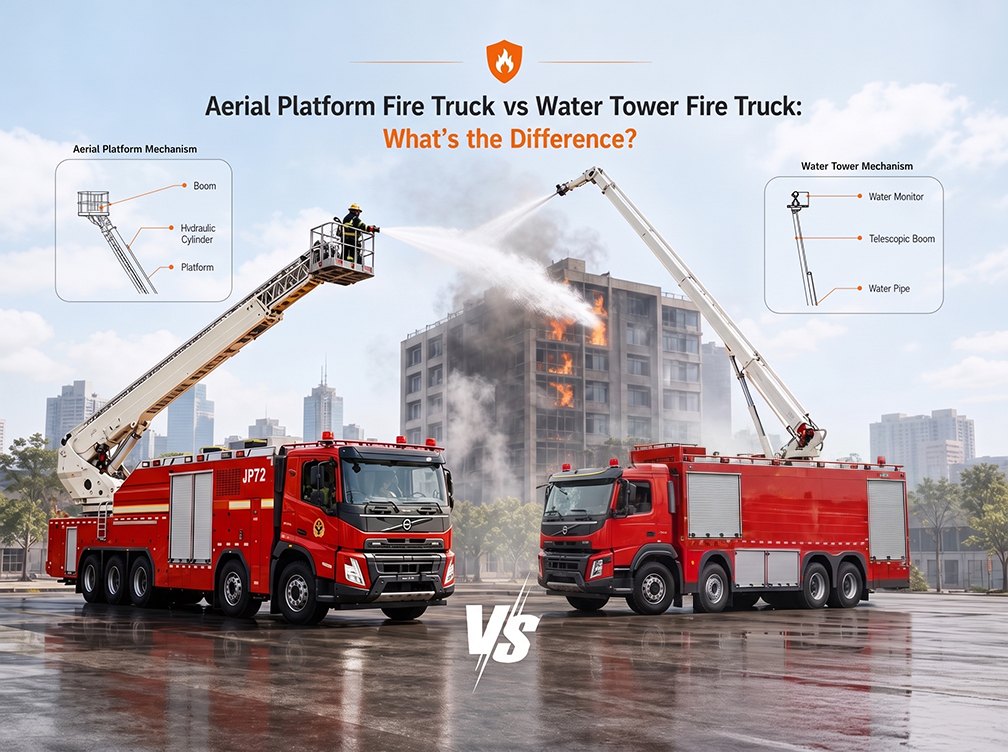
Lorsqu'il s'agit de combattre des incendies dans des immeubles de grande hauteur, des installations industrielles ou de grands entrepôts, les camions de pompiers aériens sont indispensables. Mais parmi les différents types d'engins aériens, deux prêtent souvent à confusion : lecamion de pompiers à plateforme aérienne et lecamion de pompiers à tour d'eau. Bien qu'ils puissent sembler similaires au premier coup d'œil — tous deux disposent de bras hydrauliques et sont conçus pour la lutte contre les incendies en hauteur — ils remplissent des missions fondamentalement différentes. Cet article présente les principales différences entre ces deux types de véhicules, aidant les professionnels des services d'incendie, les responsables des achats et les distributeurs d'équipements à prendre des décisions éclairées en fonction des besoins opérationnels. I. Que sont les camions à plateforme aérienne ? Selon la norme nationale chinoise GB 7956.12-2015, les deux véhicules appartiennent à la catégorie desvéhicules aériens de lutte contre les incendies— des véhicules équipés de bras élévateurs, de tourelles rotatives et d'équipements de lutte contre l'incendie pour les opérations en hauteur. Cependant, leurs définitions spécifiques mettent en évidence une distinction essentielle. Camion de pompiers à plateforme aérienne Un camion de pompiers à plateforme aérienne est équipé d'un bras combiné pliant ou pliant-télescopique, d'une plateforme pour personnel, d'une tourelle rotative et de dispositifs de lutte contre l'incendie. La caractéristique distinctive est laplateforme de travail (nacelle) à l'extrémité du bras, où les pompiers peuvent se tenir pour effectuer des opérations de sauvetage et de lutte contre l'incendie. Caractéristiques principales :• Équipé d'une plateforme pouvant transporter750 livres à plus de 1 500 livres de personnel et d'équipement• Conçu à la fois pour lesauvetage et la lutte contre l'incendie— les pompiers peuvent intervenir directement depuis la plateforme• La plateforme peut être utilisée avec des dispositifs de contrôle de descente, des treuils hydrauliques ou des toboggans de sauvetage• Une portée horizontale plus large et une plus grande amplitude de travail par rapport aux tours d'eau II. Que sont les camions de pompiers à tour d'eau ? Un camion de pompiers à tour d'eau est équipé d'un bras combiné pliant ou pliant-télescopique, d'une tourelle rotative et de dispositifs de lutte contre l'incendie —sans plateforme pour personnel. À la place, un canon à eau (lance d'incendie) est monté à l'extrémité du bras et peut être commandé à distance depuis le sol. Caractéristiques principales :• Aucune plateforme pour personnel— les pompiers interviennent depuis le sol via une commande à distance• Axé exclusivement sur l'extinction des incendies en hauteur, et non sur le sauvetage• Fournit un débit d’eau exceptionnellement élevé—dépassant 2 000 gallons par minutesur de nombreux modèles industriels• Conçu pour la protection incendie industri...
Détails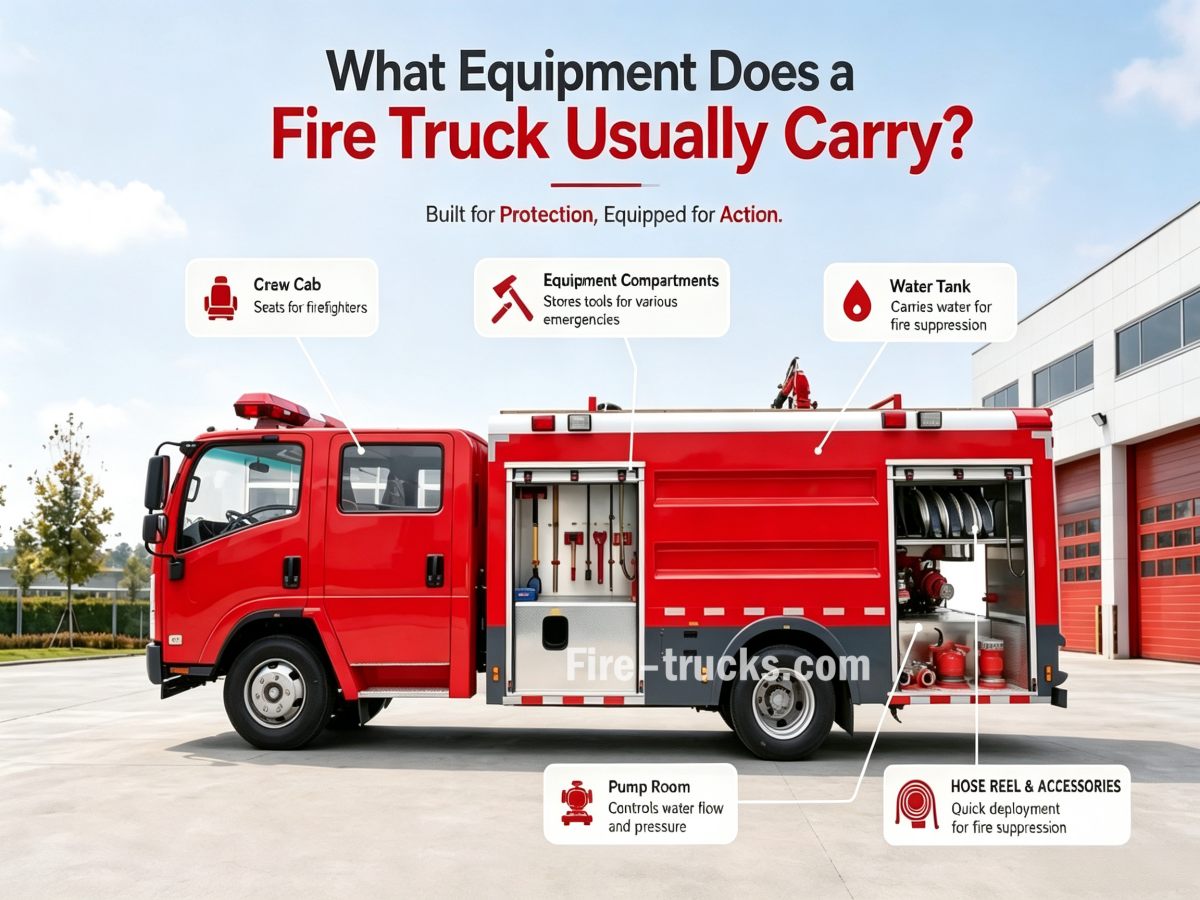
Un camion de pompiers transporte généralement des équipements de lutte contre l'incendie, d'approvisionnement en eau, de sauvetage et de protection de sécurité. Les équipements courants comprennent les pompes à incendie, les réservoirs d'eau, les tuyaux d'incendie, les lances d'incendie, les canons à eau, les vannes, les échelles d'incendie, les outils de sauvetage, les équipements de protection et les dispositifs de communication. Cet article détaille systématiquement la classification, les fonctions et les considérations de sélection des équipements standard decamion de pompierséquipements, aidant les professionnels des achats et les utilisateurs finaux à acquérir une compréhension complète des configurations des véhicules d'incendie. I. Classification des équipements des camions de pompiers 1. Équipements de lutte contre l'incendie— Outils essentiels pour l'extinction directe des incendies, notamment les lances d'incendie, les canons à eau, les tuyaux d'incendie, les diviseurs d'eau et les adaptateurs. 2. Équipements de sauvetage et de franchissement— Outils permettant de créer des voies d'accès pour les opérations de sauvetage et de lutte contre l'incendie, notamment les outils hydrauliques de sauvetage, les haches d'incendie, les leviers, les pieds-de-biche, les scies à tronçonner et les tronçonneuses. 3. Équipements de sauvetage et de protection de la vie— Équipements destinés à la recherche, au transport et à la protection du personnel, notamment les brancards, les cordes de sauvetage, les crochets de sécurité, les dispositifs de contrôle de descente, les appareils respiratoires autonomes (ARA) et les bouteilles d'air de rechange. 4. Équipements d'évacuation des fumées et d'éclairage— Équipements destinés à améliorer les conditions sur le lieu d'incendie, notamment les extracteurs de fumée, les mâts d'éclairage mobiles et les projecteurs portables de recherche à haute intensité. 5. Équipements de protection individuelle (EPI)— Équipements destinés à protéger la sécurité des pompiers, notamment les casques, les vêtements de protection pour la lutte contre les incendies structurels, les gants, les bottes et les ceintures de sécurité. 6. Équipements de communication et de reconnaissance— Équipements destinés à la collecte d'informations sur le lieu d'incendie et à la coordination du commandement, notamment les radios bidirectionnelles, les caméras thermiques et les détecteurs de gaz toxiques. II. Équipements de lutte contre l'incendie sur les camions de pompiers 1. Pompe à incendie La pompe à incendie est la source d'énergie de toutes les opérations de lutte contre l'incendie. Elle met mécaniquement l'eau sous pression, lui donnant une énergie cinétique suffisante pour accomplir le processus complet « aspiration → pressurisation → acheminement → décharge ». Spécifications typiques des pompes à incendie : •Pompe à incendie standard pression (type CB10/30) :Débit ≥30 L/s, pression nominale 1,0 MPa, installation montée à l'arrière. Convient aux ...
Détails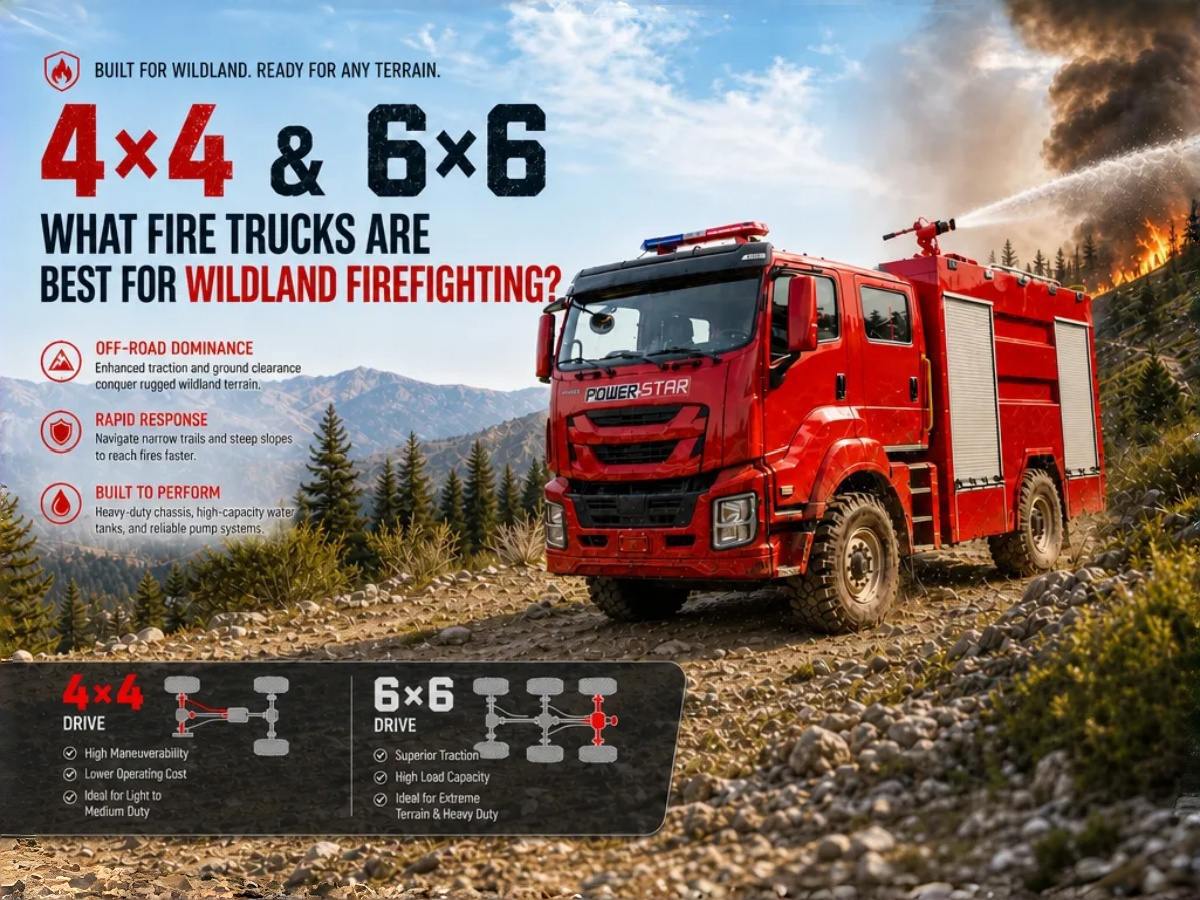
La lutte contre les incendies de végétation présente des défis fondamentalement différents de ceux de la lutte contre les incendies de structures. Dans les forêts isolées, les prairies et les terrains montagneux, les camions de pompiers doivent emprunter des sentiers étroits, gravir des pentes abruptes et fonctionner loin des bouches d'incendie ou des sources d'eau. Le choix du bon camion de lutte contre les incendies est une décision stratégique qui a un impact direct sur le temps d'intervention, la sécurité des équipes et l'efficacité de l'extinction des incendies. Cet article fournit une analyse complète des types de camions de pompiers les plus adaptés à la lutte contre les incendies de végétation, de leurs caractéristiques principales et des méthodes de sélection, afin de vous aider à prendre la bonne décision en fonction de vos besoins opérationnels spécifiques. Réponse rapide Les incendies de végétation se caractérisent par de vastes zones en feu, des terrains complexes, des sources d'eau limitées et de mauvaises conditions routières. Il n'existe donc pas un seul camion de pompiers capable de gérer tous les scénarios d'incendie de forêt. En général, la lutte contre les incendies de végétation utilise principalement les types de camions de pompiers suivants : • Camions légers de lutte contre les incendies de végétation : pour l'accès aux routes forestières et les interventions rapides• Camions 4×4 tout-terrain de lutte contre les incendies de végétation : pour les terrains montagneux et vallonnés• Camions 6×6 de lutte contre les incendies de végétation : pour les incendies de forêt de grande ampleur et les opérations prolongées• Camions-citernes : pour l'approvisionnement continu en eau et le soutien• Camions d'incendie à mousse : pour les installations pétrolières, les équipements forestiers ou les incendies spéciaux• Véhicules de secours : pour les communications, l'éclairage, le franchissement d'obstacles et le soutien logistique I. Pourquoi les incendies de végétation nécessitent-ils des camions de pompiers spécialisés ? Les incendies de végétation diffèrent fondamentalement des incendies de structures de plusieurs façons essentielles : Caractéristiques principales des incendies de végétation :• Grandes zones d'incendie couvrant des hectares de terrain• Changements rapides de direction du vent• Terrain complexe et accidenté• Accès limité ou inexistant aux bouches d'incendie ou aux sources d'eau• Routes forestières étroites et non pavées• Conditions de communication difficiles Les camions de pompiers urbains standard ne conviennent généralement pas à la lutte contre les incendies de végétation pour les raisons suivantes : •Absence de transmission 4×4 ou de quatre roues motrices pour les routes de montagne non pavées et les pentes abruptes ;•Leur taille plus importante et leur faible garde au sol les rendent susceptibles de rester bloqués sur les sentiers forestiers étroits et les terrains meubles ;•Les pompes urbaines privilégient un déb...
Détails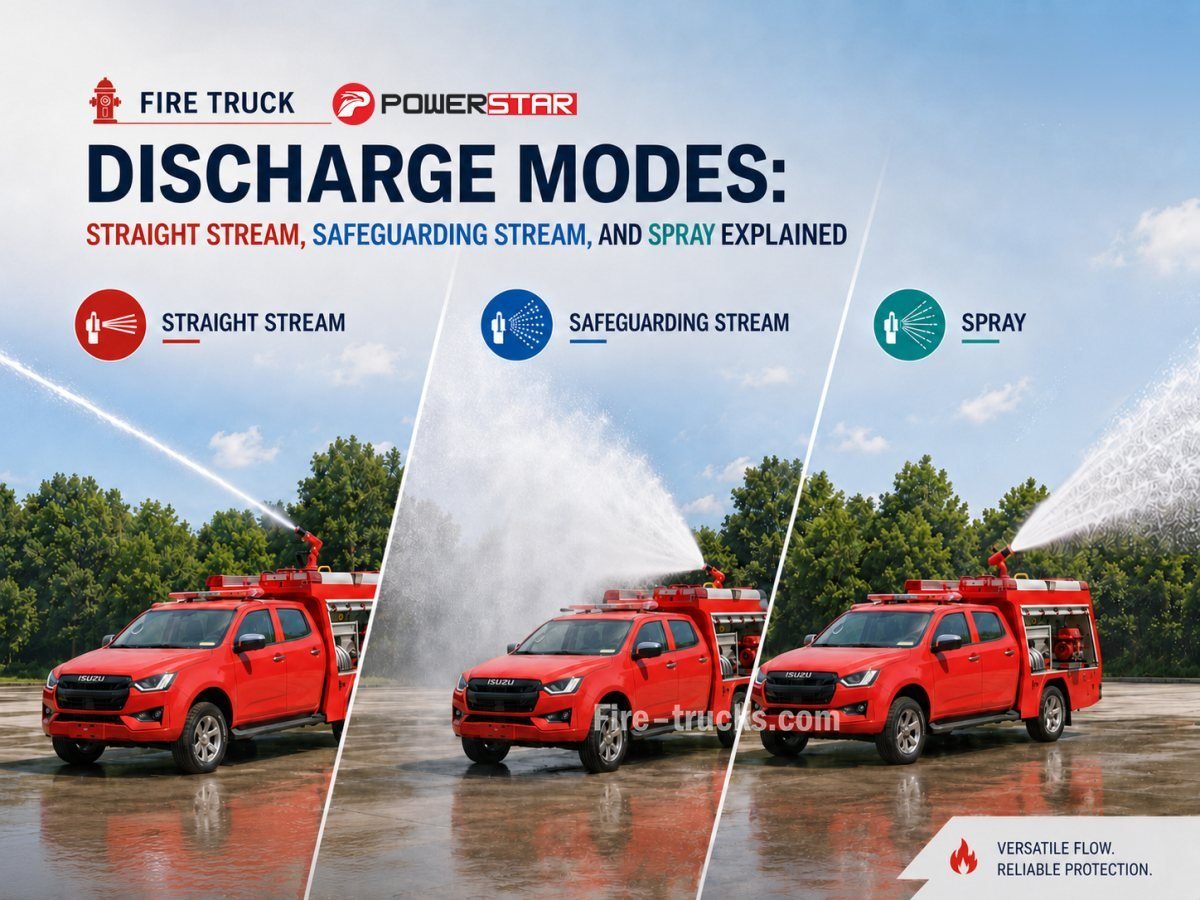
Dans les opérations de lutte contre l'incendie, la sélection du mode de jet détermine directement l'efficacité de l'extinction, la sécurité opérationnelle et l'efficacité du contrôle du feu. La plupart des gens ignorent quecamion de pompiersles lances peuvent basculer entre trois modes de jet principaux : jet droit, jet diffusé et jet de protection. Les différents modes varient considérablement en termes de forme d'écoulement, de portée, de force d'impact et de zone de couverture, et chacun correspond à des scénarios d'incendie applicables complètement différents. Cet article, basé sur les normes professionnelles d'exploitation de la lutte contre l'incendie, analyse de manière exhaustive les principes, les caractéristiques clés et les scénarios d'application des trois modes de jet, aidant nos clients à maîtriser systématiquement les techniques de décharge des camions de pompiers. I. Pourquoi les camions de pompiers ont-ils besoin de différents modes de jet ? Le jet droit, le jet diffusé et le jet de protection correspondent à trois mécanismes d'extinction différents : extinction par impact, étouffement par vaporisation et protection contre le rayonnement thermique. Les pompiers doivent changer de mode avec souplesse selon les conditions du site. Alors,pourquoi ne pouvons-nous pas utiliser un seul type de jet en permanence ? 1. La diversité des types d'incendie nécessite différentes formes d'agents extincteurs Les différents types d'incendie présentent des caractéristiques de combustion différentes, qui déterminent la méthode d'extinction appropriée : • Les incendies de matériaux solides de classe A nécessitent l'impact d'un jet droit pour désagréger les matériaux en combustion et pénétrer afin d'assurer un refroidissement interne ; • Les incendies de liquides de classe B ne peuvent pas utiliser l'impact d'un jet droit (qui provoque des éclaboussures et propage l'incendie), mais doivent utiliser un jet de protection ou un jet diffusé pour couvrir et diluer ; • Les incendies électriques sous tension de classe E ne peuvent utiliser qu'un jet diffusé, car les fines gouttelettes d'eau ne forment pas de trajet conducteur continu ; • Les incendies dans des espaces clos nécessitent un jet diffusé pour remplir tout l'espace, permettant l'extinction par absorption de chaleur lors de la vaporisation et étouffement. Aucun mode unique ne peut s'adapter à tous les types d'incendie. 2. Les différentes phases d'un même incendie nécessitent différentes approches tactiques Même pour un même incendie, les différentes phases nécessitent différents modes de jet : • Au stade initial, lorsque le feu est intense, un jet droit est nécessaire pour un impact à longue portée sur le foyer afin d'obtenir une suppression rapide ; • Pendant la progression, un jet de protection est nécessaire pour former une barrière de rideau d'eau afin de bloquer le rayonnement thermique et protéger le personnel ; • Avant d'entrer dans une pièce, un jet diffusé est nécessaire pour refroidir et...
Détails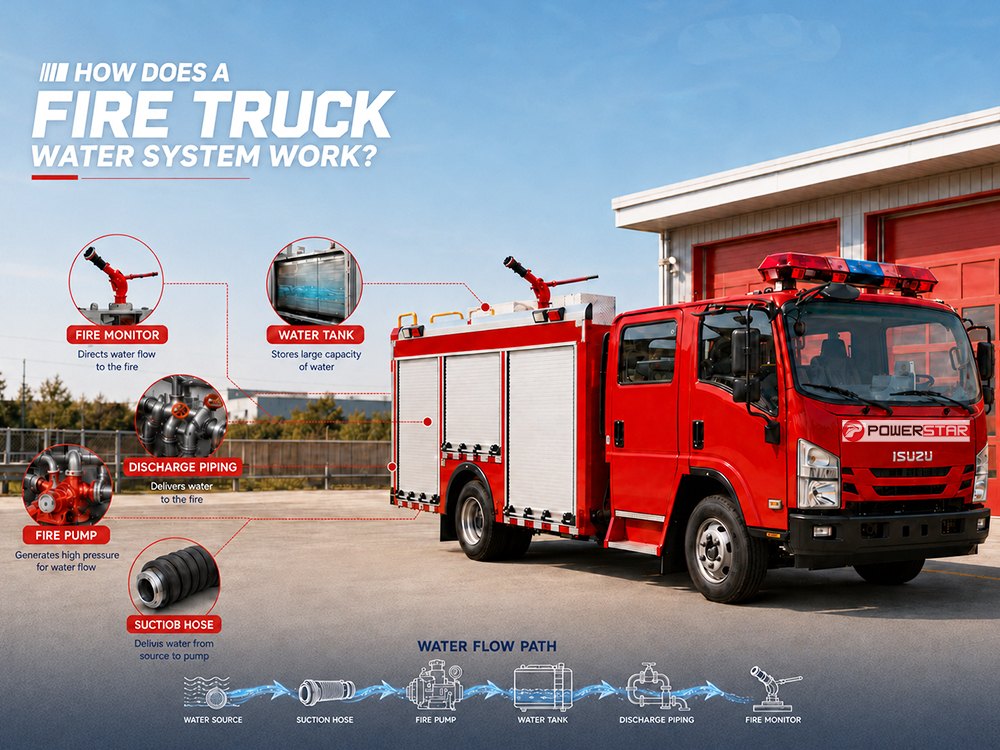
Le système de plomberie hydraulique d’un camion de pompiers est le cœur de chaque opération de lutte contre l’incendie. Il dirige avec précision l’eau depuis le réservoir ou une source externe à travers la pompe, les vannes et les tuyauteries afin de fournir de l’eau ou de la mousse à haute pression sur le lieu de l’incendie — qu’il s’agisse d’un feu dans un immeuble de grande hauteur au cœur d’une ville densément peuplée ou d’un incendie de réservoir de stockage pétrochimique dans une zone industrielle. Le camion de pompiers système de plomberie hydraulique se compose de plusieurs composants fonctionnant ensemble : pompe incendie, réservoir d’eau, tuyau d’aspiration, tuyauterie de refoulement, vannes, collecteur de division, collecteur de rassemblement, crépine, canon incendie, raccords de tuyaux, et plus encore. Le parcours complet du flux est : Réservoir d’eau → Tuyau d’aspiration → Crépine → Pompe incendie → Système de régulation de pression → Collecteur de refoulement → Vannes → Collecteur de division → Canon incendie / Raccords de tuyaux → Buse Cet article explique chaque composant du système de plomberie hydraulique et comment ils fonctionnent ensemble pour fournir de l’eau à la pression et au débit appropriés. I. Composants principaux du système de plomberie hydraulique Réservoir d’eau Stocke l’approvisionnement en eau embarqué. ● Capacité : Généralement 2 000 à 12 000 litres. ● Alimentation : Fournit de l’eau à la pompe par la tuyauterie d’admission. ● Caractéristiques : Cloisons anti-ballottement pour la stabilité du véhicule, crépine pour filtrer les débris et système d’amorçage pour l’aspiration depuis des sources d’eau naturelles. Pompe incendie Une pompe centrifuge entraînée par le moteur du camion via une prise de force (PTO) ; à un ou plusieurs étages, en fonte ou en bronze. ● Classes de pression: Disponibles avec des valeurs nominales standard de 0,8 MPa, 1,0 MPa, 1,2 MPa et 1,4 MPa, adaptées aux exigences courantes de la lutte contre l’incendie. ● Débits: De 1 200 à 6 000 L/min, avec des courbes de performance optimisées pour les opérations à haute pression comme pour celles nécessitant un grand volume d’eau. Vannes et tuyauteries Un réseau de tuyaux et de vannes qui contrôle la direction et le volume du débit d’eau. ● Vanne d’admission: Relie la pompe aux sources d’eau externes (borne d’incendie ou point d’aspiration) ● Vanne réservoir-pompe: Permet à la pompe de puiser directement l’eau du réservoir embarqué ● Vannes de refoulement: Contrôlent le débit d’eau vers les tuyaux et les buses II. Fonctionnement du système de plomberie hydraulique d’un camion de pompiers Étape 1 : Prise d’eau et amorçage L’eau entre dans le système depuis le réservoir embarqué, une borne d’incendie ou des sources d’eau naturelles (lacs, rivières, étangs). Lors d’une aspiration depuis des sources naturelles, le système d’amorçage (pompe à vide) élimine l’air du tuyau d’aspiration, créant un vide qui permet à la pression atmosphérique de pousser l’eau...
Détails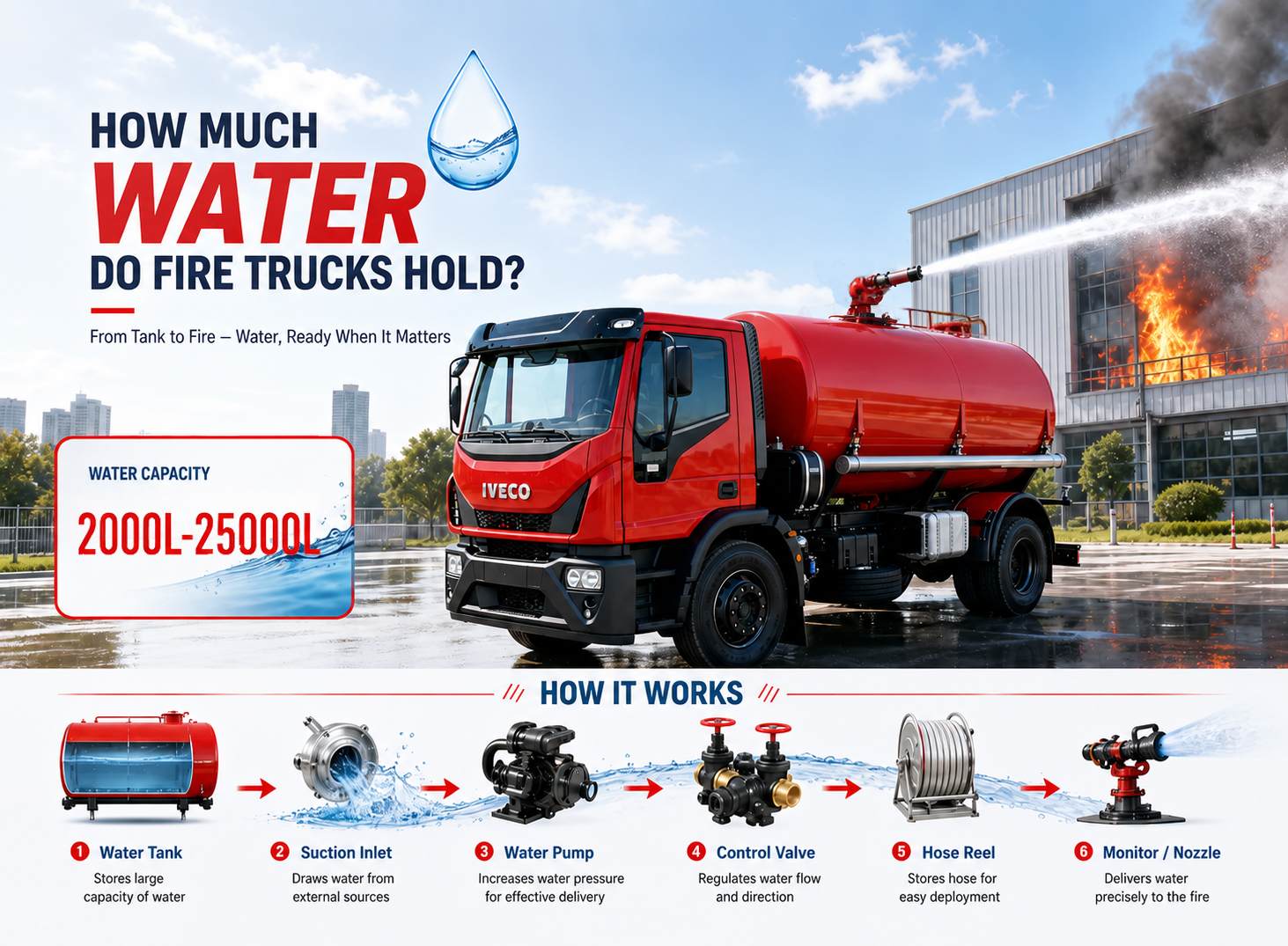
Quelle quantité d’eau un camion de pompiers peut-il transporter ? C’est l’une des premières questions auxquelles nos clients sont confrontés lorsqu’ils choisissent un camion de pompiers. Il n’existe pas de nombre fixe unique : cela dépend du type de véhicule, de la capacité du châssis, de la conception prévue et des réglementations régionales, allant des unités légères de 2 000 litres aux camions de pompiers industriels de 25 000 litres. Cependant, un réservoir plus grand ne signifie pas toujours de meilleures performances ;véhicule de lutte contre l’incendie la capacité du réservoir d’eau doit être correctement adaptée au débit de la pompe, au débit de décharge du canon et à la capacité du châssis afin d’obtenir des résultats efficaces de lutte contre l’incendie. Cet article commence par les principes fondamentaux de la capacité des réservoirs d’eau des camions de pompiers, analyse les plages de stockage typiques pour différents types de véhicules, examine les principaux facteurs qui influencent la conception des réservoirs et fournit des conseils pratiques pour l’achat. Points clés à retenir : La capacité du réservoir d’eau d’un camion de pompiers varie généralement de 2 000 à 25 000 litres Les différents types de camions de pompiers ont des capacités de réservoir différentes Un réservoir plus grand ne signifie pas une meilleure capacité de lutte contre l’incendie La capacité du réservoir doit être adaptée au débit de la pompe, au débit du canon et à la capacité du châssis La lutte contre les incendies industriels nécessite généralement de grands réservoirs, tandis que la lutte contre les incendies municipaux privilégie la maniabilité » I. Trois types de base de réservoirs d’eau pour camions de pompiers Camions d’intervention avec pompe :Ce sont les camions de pompiers municipaux les plus courants. Ils dépendent principalement des bornes d’incendie pour l’approvisionnement en eau et transportent environ 1 900 à 3 800 litres d’eau embarquée pour l’attaque initiale. Le cœur de ces véhicules est la pompe, et non le réservoir : ils sont conçus pour fournir de l’eau sous pression une fois raccordés à une borne d’incendie. Camions-citernes (ravitailleurs en eau) :Ces véhicules sont dédiés au transport de grands volumes d’eau, avec des capacités de réservoir dépassant généralement 11 400 litres. Ils jouent un rôle essentiel dans les zones rurales et isolées où les bornes d’incendie ne sont pas disponibles, en transportant l’eau des sources d’approvisionnement jusqu’au lieu de l’incendie pour que les camions-pompes puissent l’utiliser. Camions pompe-citerne :Ces véhicules combinent les fonctions de pompage et de transport d’eau en une seule unité. Ils peuvent à la fois projeter de l’eau pour la lutte contre l’incendie et approvisionner d’autres véhicules. Les capacités de réservoir varient généralement de 5 700 à 11 400 litres, ce qui en fait une solution polyvalente pour les services d’incendie. » II. Quelle quantité d’eau les différents types de cami...
Détails
Veuillez lire la suite, restez informés, abonnez-vous, et n'hésitez pas à nous faire part de vos commentaires.

 Network IPv6 pris en charge

 français
 English
 Deutsch
 русский
 italiano
 español
 português
 Nederlands
 العربية
 日本語
日本語 한국의
한국의 Türkçe
 Melayu
 ไทย
ไทย Tiếng Việt
 Indonesia
  中文
中文 қазақ
қазақ Filipino
 မြန်မာ
 српски