Laisser un message
Si vous êtes intéressé par nos produits et souhaitez en savoir plus, veuillez laisser un message ici, nous vous répondrons dès que possible.

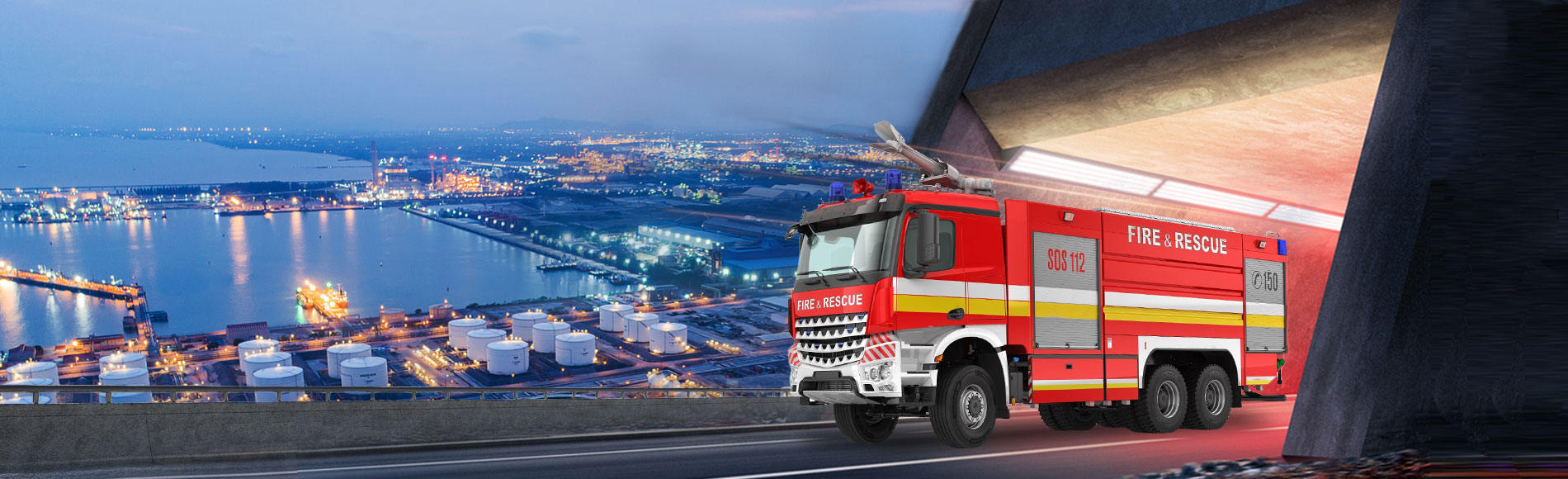
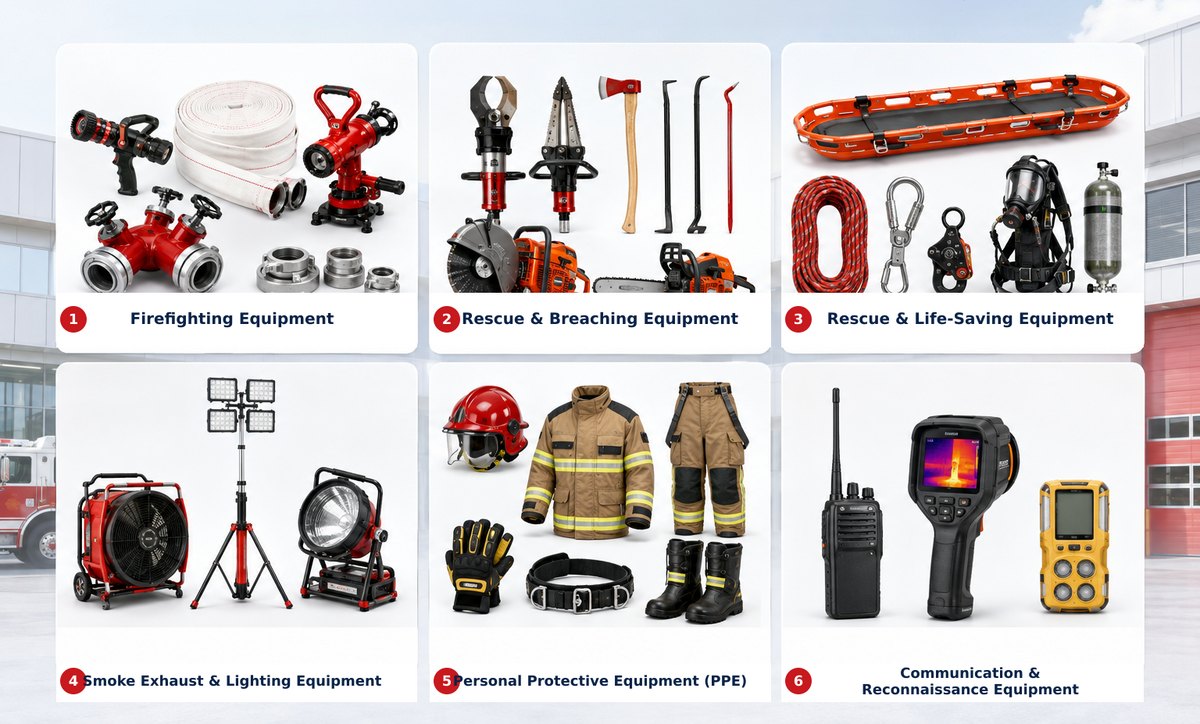
A fire truck typically carries firefighting, water supply, rescue, and safety protection equipment. Common equipment includes fire pumps, water tanks, fire hoses, fire nozzles, fire monitors, valves, fire ladders, rescue tools, protective gear, and communication devices. This article systematically breaks down the classification, functions, and selection considerations of standard fire truck equipment, helping procurement professionals and end-users build a complete understanding of fire apparatus configurations.
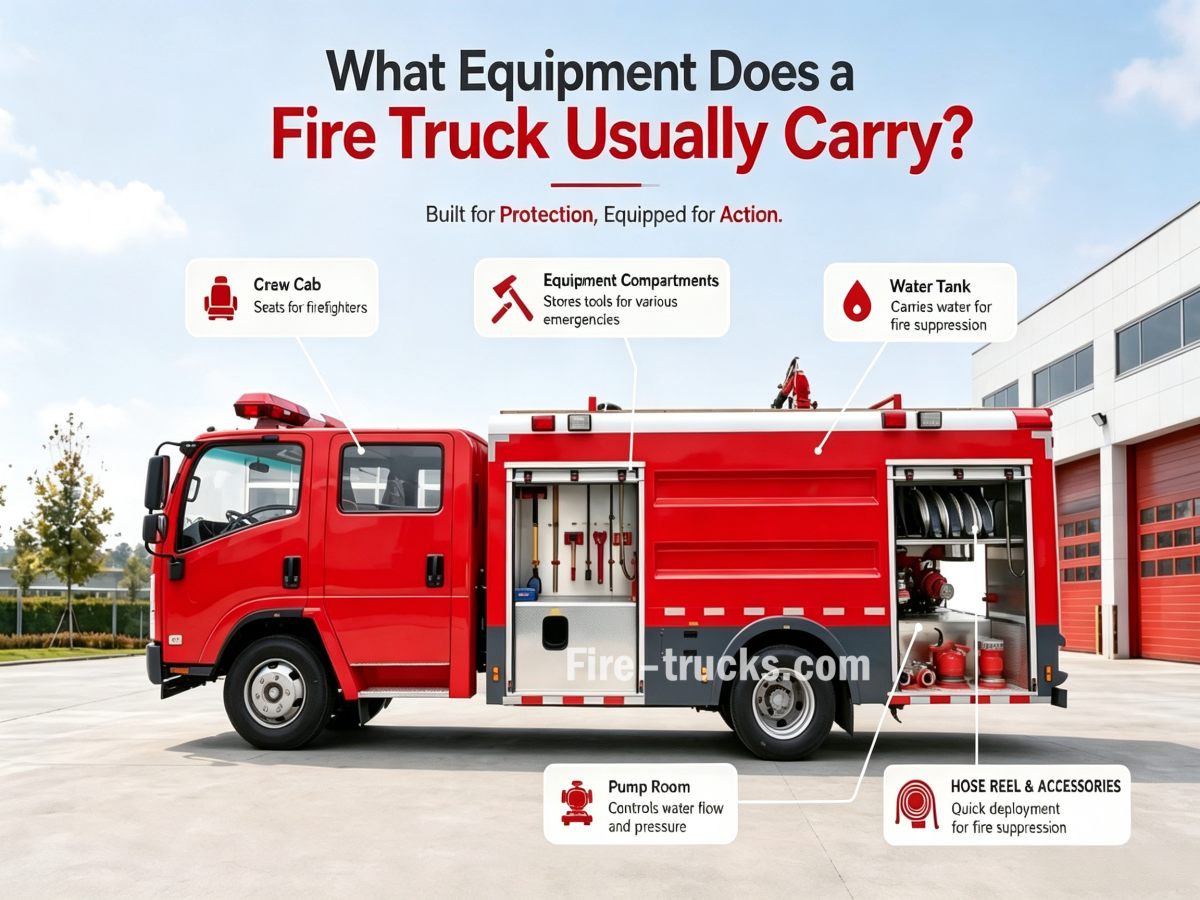
1. Firefighting Equipment — Core tools for direct fire suppression, including fire nozzles, fire monitors, fire hoses, water dividers, and adapters.
2. Rescue and Breaching Equipment — Tools for creating access routes for rescue and firefighting operations, including hydraulic rescue tools, fire axes, pry bars, crowbars, cut-off saws, and chain saws.
3. Rescue and Life-Saving Equipment — Equipment for search, transfer, and protection of personnel, including stretchers, rescue ropes, safety hooks, descent control devices, self-contained breathing apparatus (SCBA), and spare air cylinders.
4. Smoke Exhaust and Lighting Equipment — Equipment for improving fireground conditions, including smoke ejectors, mobile lighting towers, and portable high-intensity searchlights.
5. Personal Protective Equipment (PPE) — Gear to protect firefighter safety, including helmets, structural firefighting protective clothing, gloves, boots, and safety belts.
6. Communication and Reconnaissance Equipment — Equipment for fireground information gathering and command coordination, including two-way radios, thermal imaging cameras, and toxic gas detectors.
The fire pump is the power source for all firefighting operations. It mechanically pressurizes water, giving it sufficient kinetic energy to complete the full process of "drafting → pressurizing → delivering → discharging."
Typical fire pump specifications:
• Standard Pressure Fire Pump (CB10/30 type): Flow rate ≥30L/s, rated pressure 1.0MPa, rear-mounted installation. Suitable for standard water tenders and foam fire trucks, meeting most urban and industrial firefighting water supply requirements.
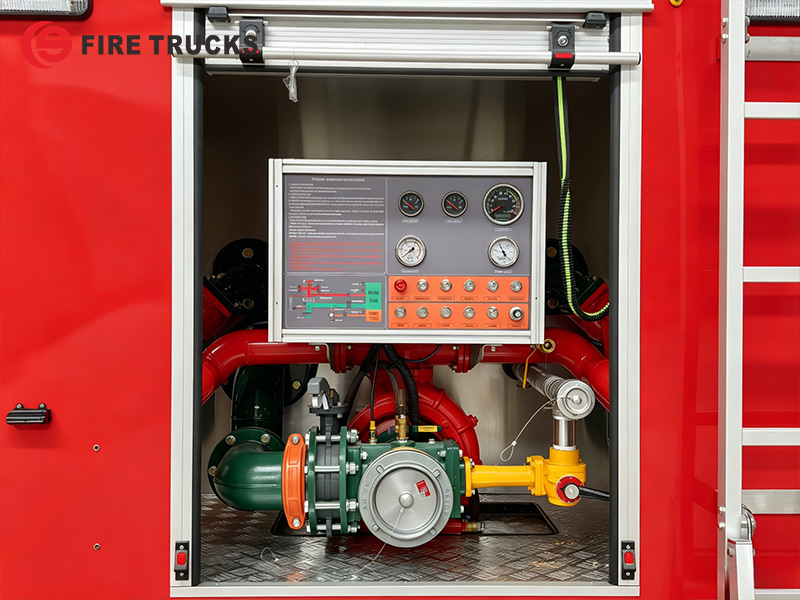
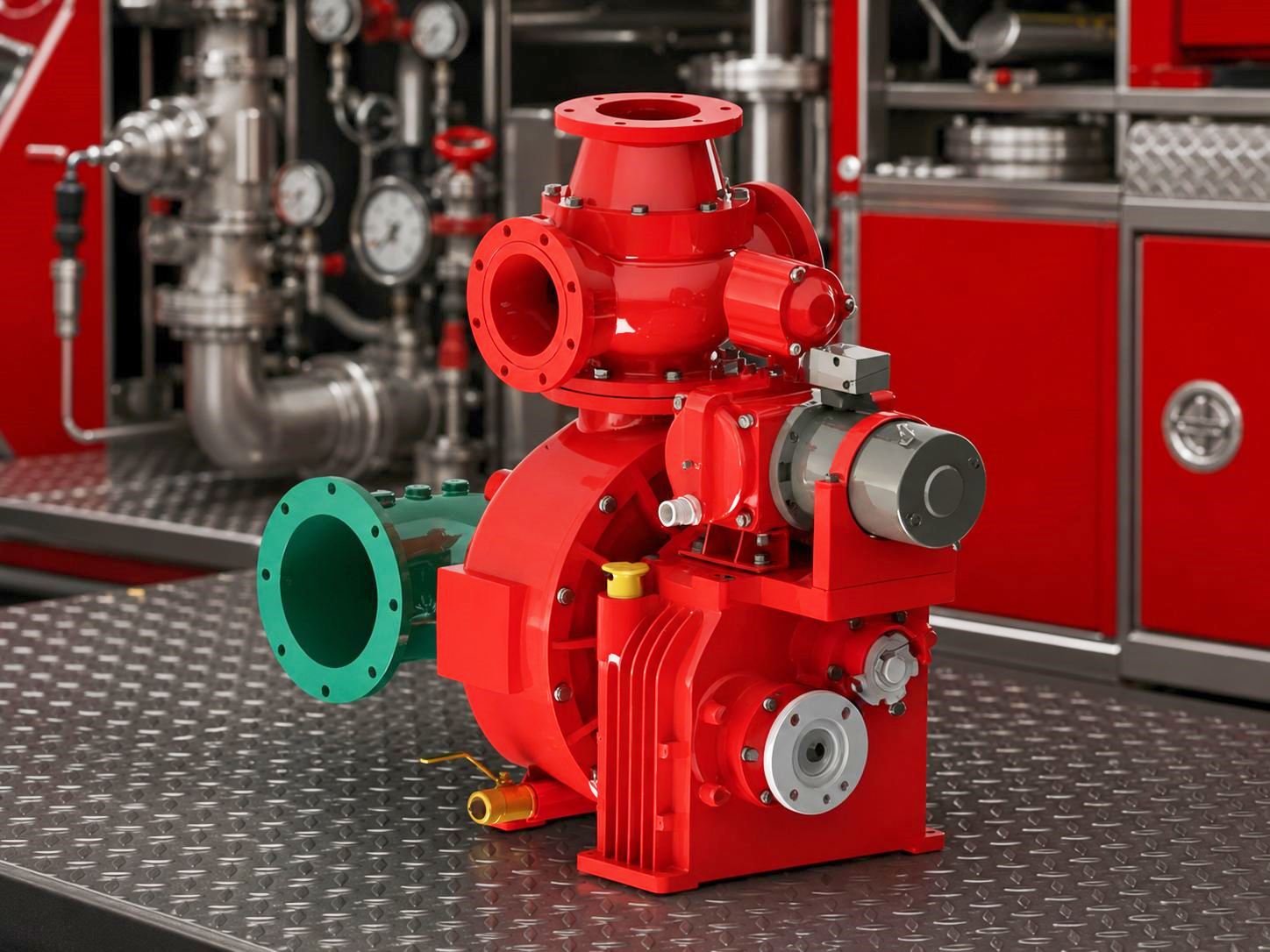
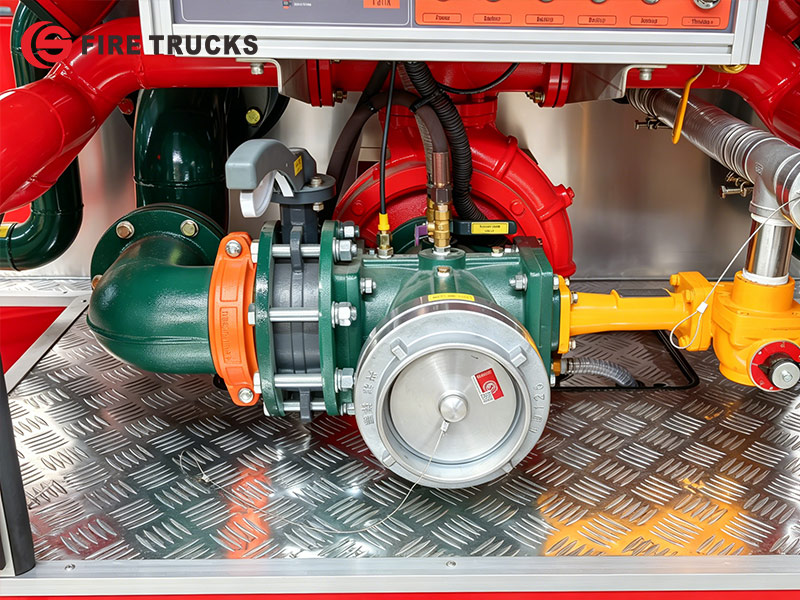
• Medium/High-Pressure Fire Pump: Low-pressure flow 30L/s at 1.0MPa, high-pressure flow 20L/s at 2.0MPa, rear-mounted installation. The dual-pressure design supports both high-volume supply (low pressure) and long-distance/high-rise delivery (high pressure) in a single pump. Ideal for urban main battle fire trucks and high-rise firefighting scenarios.
• High-Pressure Fire Pump: Flow rate 10-15L/s, pressure up to 4.0MPa or higher, rear-mounted or midship-mounted. Used in high-pressure water mist systems, commonly found on airport fire trucks and specialized industrial vehicles.
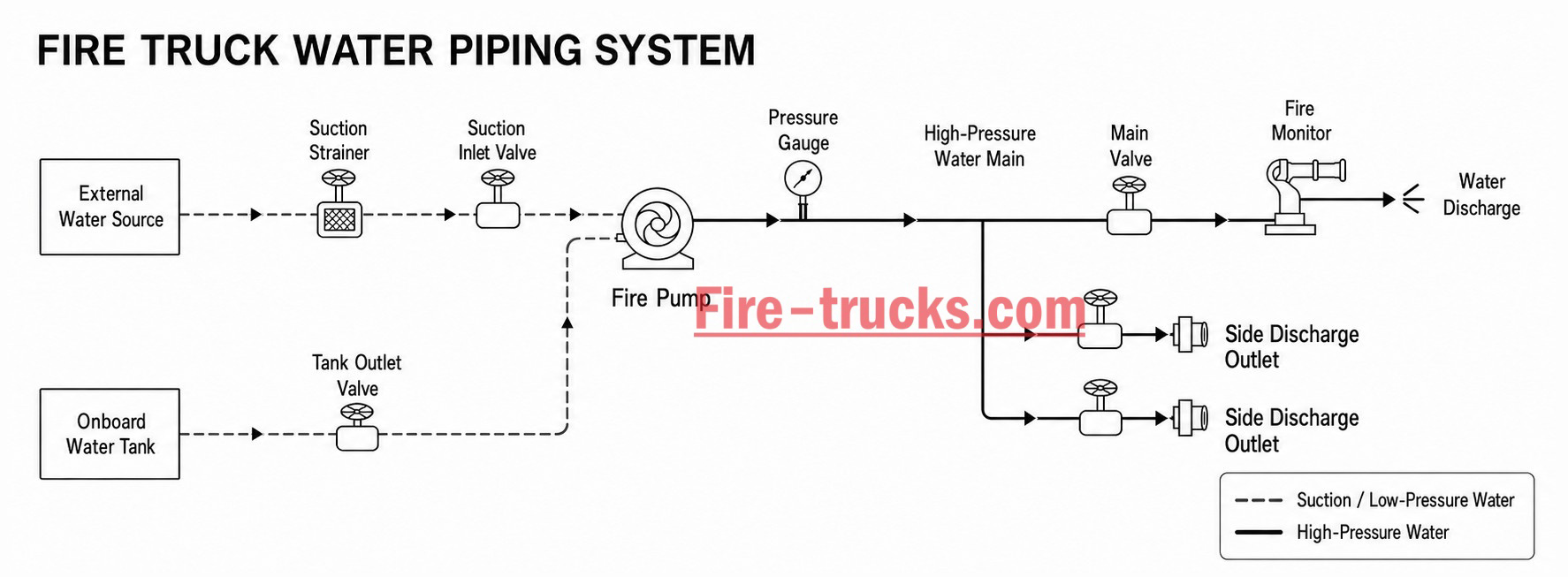
Complete water system flow path:
Water tank / Natural water source → Fire Pump (core) → Discharge outlets → Water divider → Fire hose → Nozzle / Monitor
 2. Fire Monitor
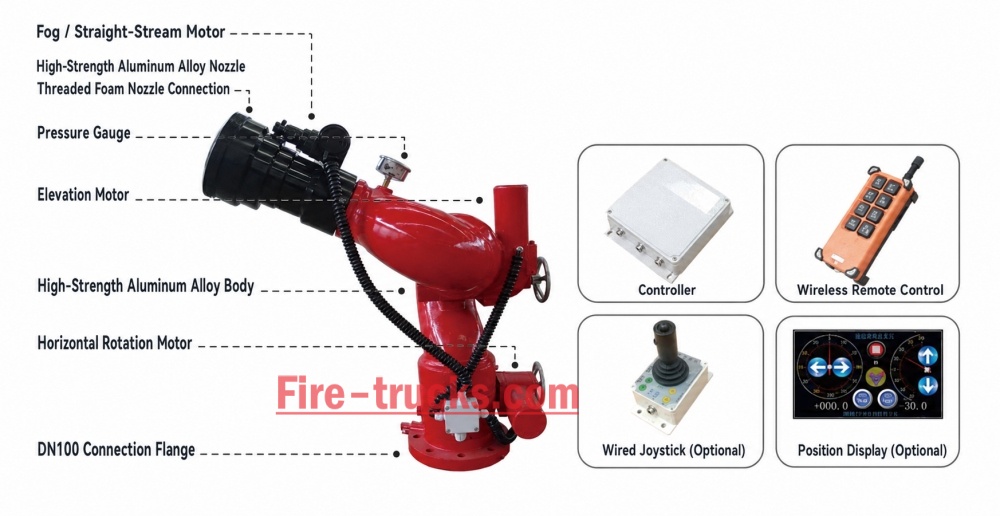
The fire monitor is a large-flow water discharge device fixed to the roof or platform of a fire truck, designed for long-range suppression of large-scale fires. By control method, monitors are classified as:
• Manual Monitor: Direction adjusted via handwheel. Simple, reliable, and low-cost. Suitable for township and industrial brigade fire trucks.
• Electrically Controlled Monitor: Operated remotely from the cab panel or handheld controller. Provides horizontal rotation (0°–360°) and elevation adjustment (-15° to +75°). Suitable for urban main battle fire trucks.
• Remote-Controlled Monitor: Operated via wireless remote control from 100–300 meters away. Suitable for high-risk scenarios such as oil tank farms, airports, and chemical fires.
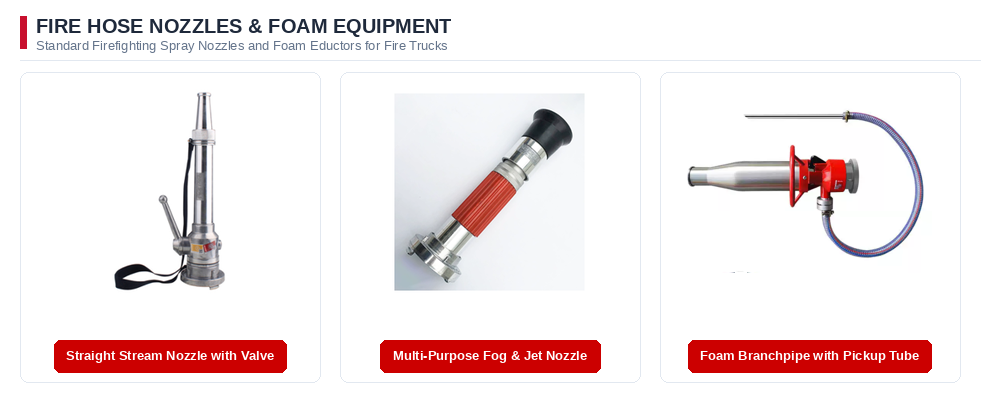
The fire nozzle is a handheld device operated by one or two firefighters, connected directly to the fire hose, converting pressurized water into a specific discharge pattern. The key difference from a fire monitor is that the nozzle is held and aimed manually—it has lower flow but greater mobility—while the monitor is fixed to a mount or platform, delivering higher flow and longer range but without mobility.
Fire nozzle classification by discharge pattern:
• Straight Stream Nozzle: Supports only straight stream mode. Simple structure, low cost, low failure rate. Suitable for township fire brigades and reserve vehicles.
• Straight/Spray Multi-Purpose Nozzle: Supports straight stream, spray, and fog patterns, switched by rotating the nozzle sleeve. The standard configuration for modern urban main battle fire trucks.
• Reaction-Force-Reducing Nozzle: Special internal flow path design reduces kickback force, making it easier and safer for firefighters to operate during extended use.
The water tank provides onboard water supply for the fire truck. Tank capacity varies by vehicle type and operational scenario. Urban fire trucks may carry smaller tanks, while industrial fire trucks typically require larger capacities for extended or high-flow firefighting operations.
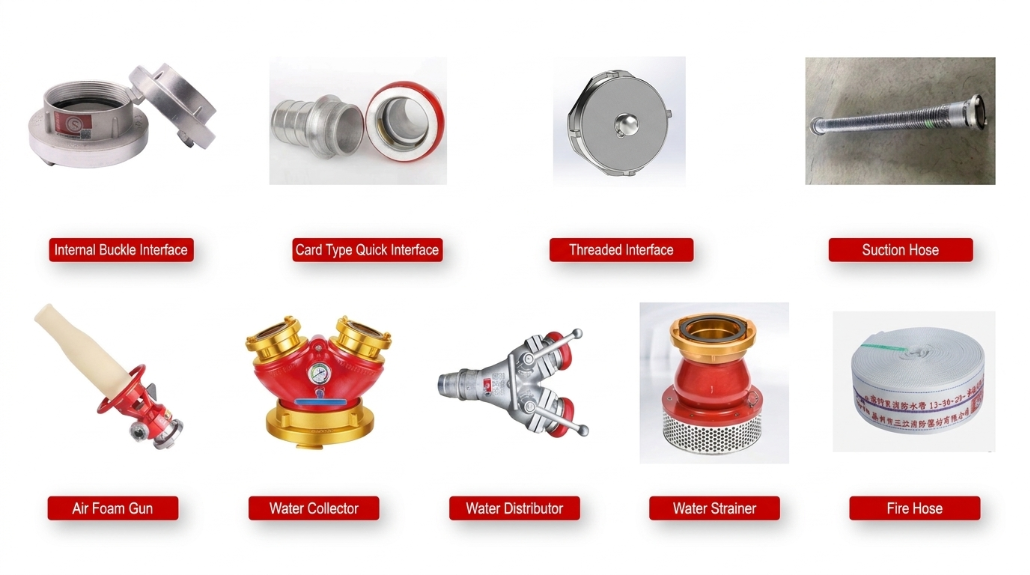
Fire hoses transport water or foam from the fire truck to the fire scene.
A typical fire truck carries:
• Discharge hose — for delivering water from the truck to the fire
• Suction hose — especially important when drafting water from ponds, rivers, reservoirs, or other external sources
Fire trucks require a complete water system to control the flow of water and extinguishing agents.
Key components include:
• Intake valves
• Discharge valves
• Tank valves
• Drain valves
• Water dividers
• Strainers
• Piping
These components direct and control water flow between the tank, pump, hoses, and monitor, ensuring efficient and reliable water delivery during operations.
Firefighters frequently operate in hazardous conditions including high heat, dense smoke, and darkness. Fire trucks may carry a range of rescue and safety equipment for such environments.
• Hydraulic Shears: Powered by hydraulic pressure to cut through rebar, metal doors, window frames, and vehicle A/B-pillars. In vehicle extrication, they quickly cut deformed chassis frames to create rescue access.
• Hydraulic Spreaders: Powered by hydraulic pressure to force open doors and lift heavy objects. Used for opening vehicle doors after collisions and creating space when limbs are trapped. Often used in combination with shears.
• Manual Breaching Tools (Fire Axe, Pry Bar, Crowbar): Operate without external power, ready at all times. The axe is used for chopping through wooden doors and windows; the pry bar for twisting, prying, and striking locked doors; and the crowbar for opening gaps and moving obstacles.
• Jack: Used to lift collapsed structural elements or heavy vehicles, creating working space for trapped personnel in building collapse and vehicle rollover rescues. Common types include hydraulic jacks and pneumatic lifting bags.
• Winch: Mounted on the front or rear of the vehicle, using steel cable or synthetic rope to tow heavy loads. Used for vehicle self-recovery, obstacle removal, and personnel transport. Essential for wilderness and complex terrain rescue.
• Lifting Air Bags: Inflated with high-pressure air to generate tens of tons of lifting force. Used for lifting collapsed floor slabs and heavy vehicles in building collapse rescue.
• Rescue Rope: Used for fall protection and personnel hauling during high-angle operations. A foundational tool for rope rescue, with high strength, abrasion resistance, and heat resistance.
• Fire Ladders: Includes roof ladders, hook ladders, and extension ladders. Used for external rescue on low-rise buildings and high-altitude operations. They are the primary means for firefighters to access elevated windows.
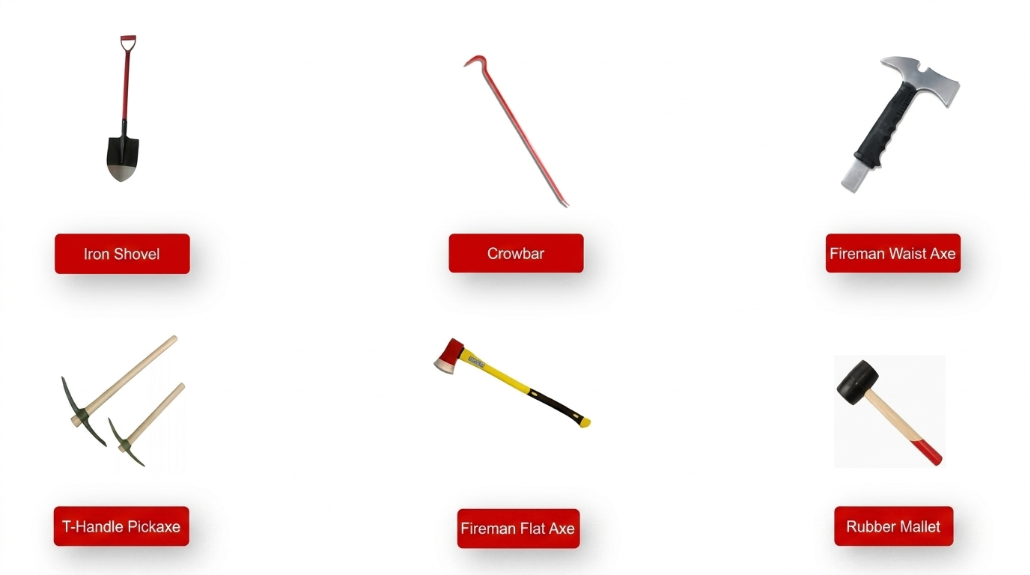
These tools are used in:
• Vehicle extrication
• Building collapse rescue
• Industrial accidents
• Other emergency rescue operation
Firefighters often work in high-temperature, smoke-filled, dark, and toxic environments. Personal protective equipment is the fundamental line of defense for firefighter safety.
Common safety equipment includes:
• Fire helmets
• Structural firefighting protective clothing
• Fire gloves
• Fire boots
• Safety goggles
• Self-Contained Breathing Apparatus (SCBA)
• Mobile lighting equipment
• Searchlights
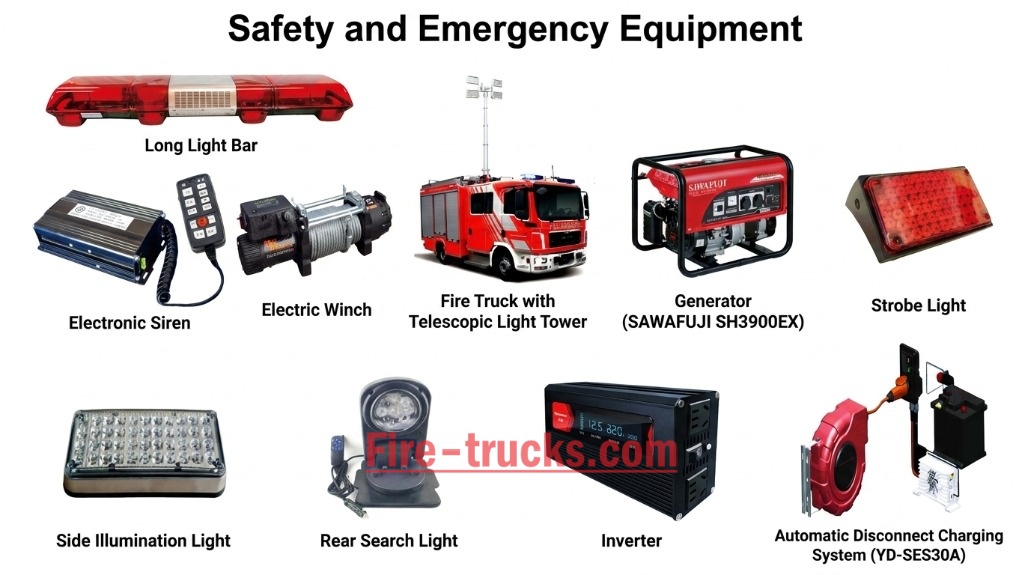
Fire trucks may also carry communication devices such as two-way radios, sirens, and public address systems to support on-site emergency operations.
When procuring a fire truck, consider the following key factors:
Fire Type
First, determine the primary fire types the vehicle will handle—such as ordinary combustible fires, flammable liquid fires, industrial fires, or forest fires.
Required Flow and Pressure
The pump, piping, hoses, nozzles, and monitors should be matched to achieve the required firefighting performance.
Operating Environment
Urban, industrial, airport, forest, and off-road environments each have different equipment requirements for fire apparatus.
Water Source Availability
If hydrants or other reliable water sources are scarce, larger water tanks and appropriate drafting equipment may be required.
Rescue Requirements
If the fire truck also handles rescue operations, additional rescue tools, lighting, ladders, and other emergency equipment may be necessary.
1. What is the most important equipment on a fire truck?
The fire pump and water supply system are the core of most fire apparatus. However, specialized fire trucks may be more dependent on foam systems, dry chemical systems, rescue tools, or aerial devices.
2. Do all fire trucks have water tanks?
No. Some fire trucks rely primarily on external water sources such as hydrants, while many water tenders and specialized fire trucks are equipped with onboard water tanks.
3. What equipment does a foam fire truck typically carry?
Foam fire trucks typically carry a water tank, foam tank, fire pump, foam proportioning system, hoses, valves, and foam monitors or foam nozzles.
4. How much hose does a fire truck usually carry?
A standard main battle fire truck typically carries 20 hose sections (20 meters each), totaling approximately 400 meters. Large water supply trucks or remote water supply systems may carry more.
5. Can fire truck equipment be customized?
Yes. Fire truck equipment can be customized based on application scenarios, fire risks, chassis capacity, local conditions, and performance requirements.
The equipment carried on a fire truck forms a complete operational system. From nozzles and hoses to breaching and rescue tools, from respiratory protection to smoke exhaust and lighting, each category plays an irreplaceable role in specific fireground operations. Proper equipment configuration not only improves firefighting and rescue efficiency but also protects firefighter safety.


Vous pouvez être intéressé par les informations suivantes
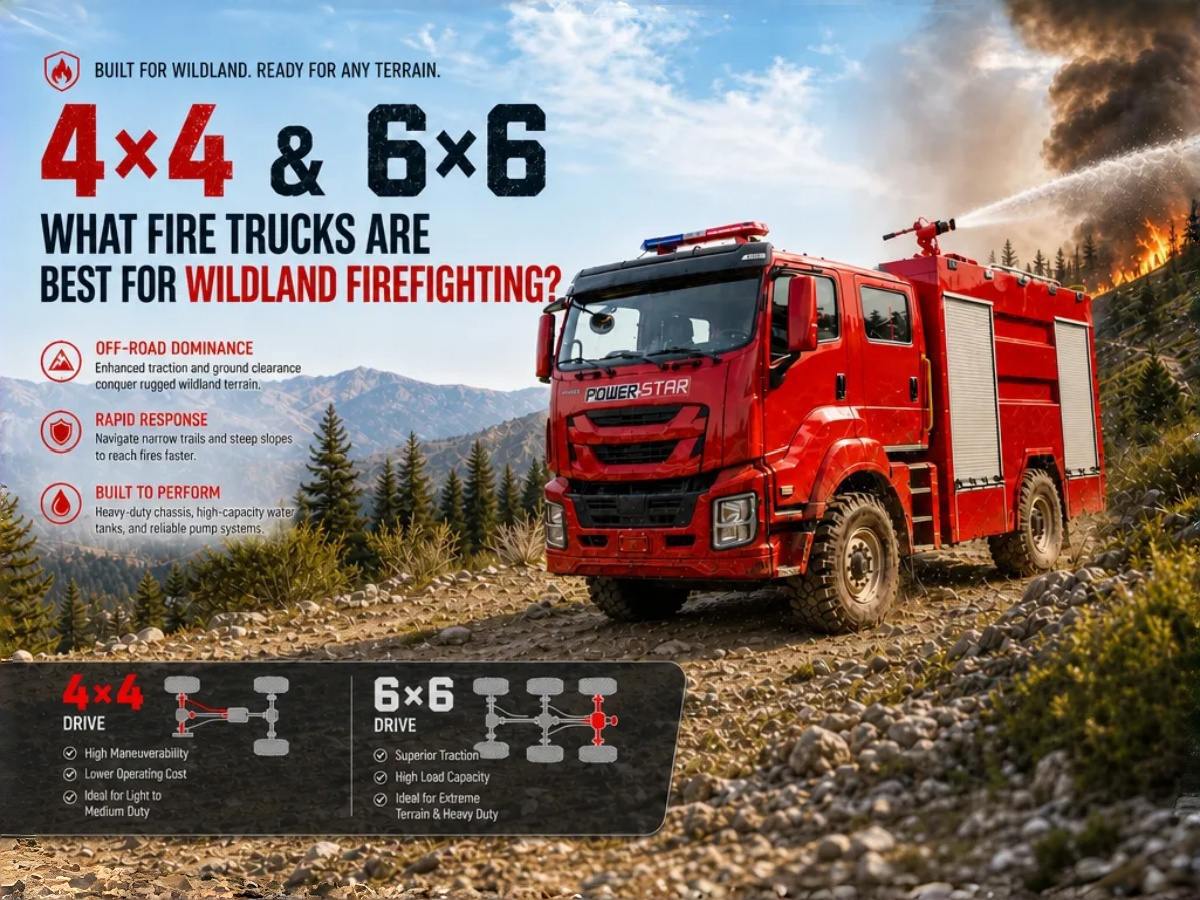
La lutte contre les incendies de végétation présente des défis fondamentalement différents de ceux de la lutte contre les incendies de structures. Dans les forêts isolées, les prairies et les terrains montagneux, les camions de pompiers doivent emprunter des sentiers étroits, gravir des pentes abruptes et fonctionner loin des bouches d'incendie ou des sources d'eau. Le choix du bon camion de lutte contre les incendies est une décision stratégique qui a un impact direct sur le temps d'intervention, la sécurité des équipes et l'efficacité de l'extinction des incendies. Cet article fournit une analyse complète des types de camions de pompiers les plus adaptés à la lutte contre les incendies de végétation, de leurs caractéristiques principales et des méthodes de sélection, afin de vous aider à prendre la bonne décision en fonction de vos besoins opérationnels spécifiques. Réponse rapide Les incendies de végétation se caractérisent par de vastes zones en feu, des terrains complexes, des sources d'eau limitées et de mauvaises conditions routières. Il n'existe donc pas un seul camion de pompiers capable de gérer tous les scénarios d'incendie de forêt. En général, la lutte contre les incendies de végétation utilise principalement les types de camions de pompiers suivants : • Camions légers de lutte contre les incendies de végétation : pour l'accès aux routes forestières et les interventions rapides• Camions 4×4 tout-terrain de lutte contre les incendies de végétation : pour les terrains montagneux et vallonnés• Camions 6×6 de lutte contre les incendies de végétation : pour les incendies de forêt de grande ampleur et les opérations prolongées• Camions-citernes : pour l'approvisionnement continu en eau et le soutien• Camions d'incendie à mousse : pour les installations pétrolières, les équipements forestiers ou les incendies spéciaux• Véhicules de secours : pour les communications, l'éclairage, le franchissement d'obstacles et le soutien logistique I. Pourquoi les incendies de végétation nécessitent-ils des camions de pompiers spécialisés ? Les incendies de végétation diffèrent fondamentalement des incendies de structures de plusieurs façons essentielles : Caractéristiques principales des incendies de végétation :• Grandes zones d'incendie couvrant des hectares de terrain• Changements rapides de direction du vent• Terrain complexe et accidenté• Accès limité ou inexistant aux bouches d'incendie ou aux sources d'eau• Routes forestières étroites et non pavées• Conditions de communication difficiles Les camions de pompiers urbains standard ne conviennent généralement pas à la lutte contre les incendies de végétation pour les raisons suivantes : •Absence de transmission 4×4 ou de quatre roues motrices pour les routes de montagne non pavées et les pentes abruptes ;•Leur taille plus importante et leur faible garde au sol les rendent susceptibles de rester bloqués sur les sentiers forestiers étroits et les terrains meubles ;•Les pompes urbaines privilégient un déb...
Détails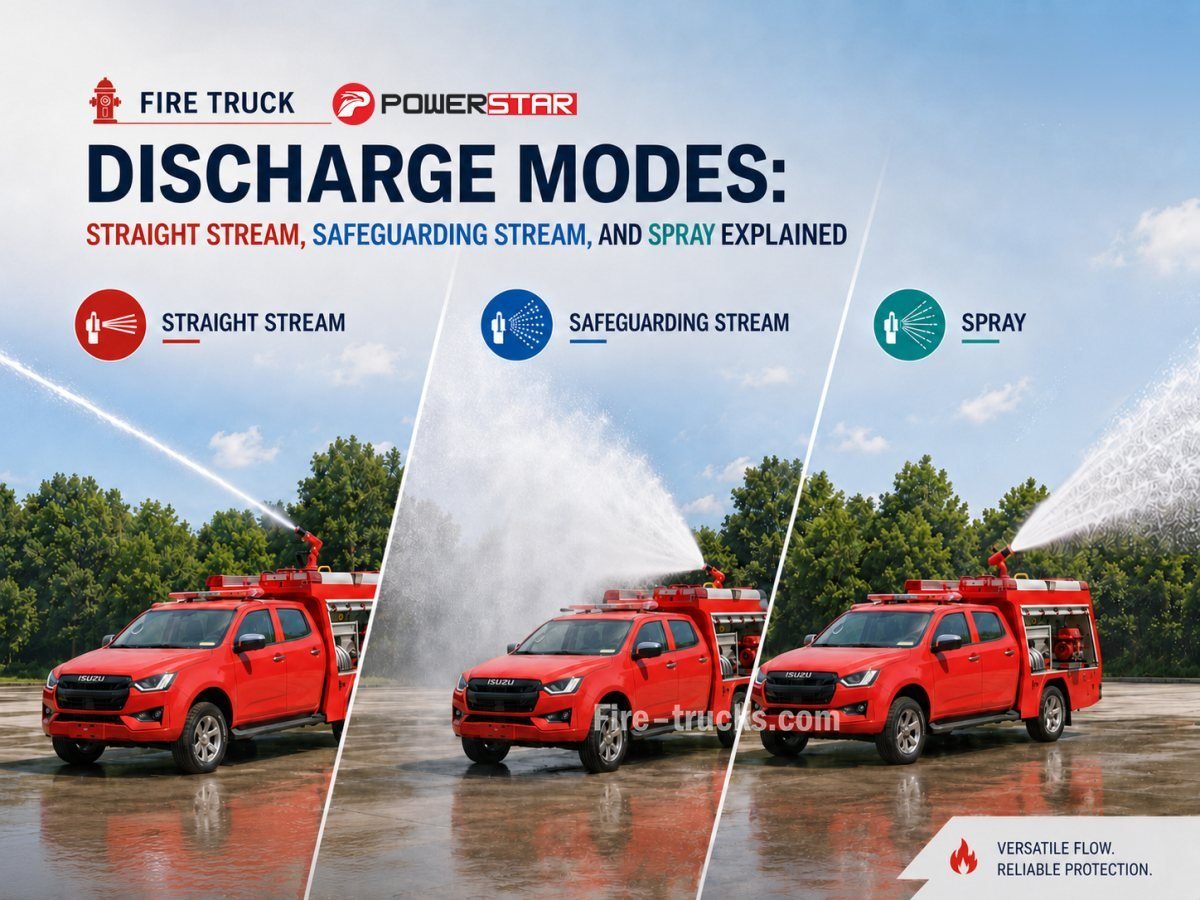
Dans les opérations de lutte contre l'incendie, la sélection du mode de jet détermine directement l'efficacité de l'extinction, la sécurité opérationnelle et l'efficacité du contrôle du feu. La plupart des gens ignorent quecamion de pompiersles lances peuvent basculer entre trois modes de jet principaux : jet droit, jet diffusé et jet de protection. Les différents modes varient considérablement en termes de forme d'écoulement, de portée, de force d'impact et de zone de couverture, et chacun correspond à des scénarios d'incendie applicables complètement différents. Cet article, basé sur les normes professionnelles d'exploitation de la lutte contre l'incendie, analyse de manière exhaustive les principes, les caractéristiques clés et les scénarios d'application des trois modes de jet, aidant nos clients à maîtriser systématiquement les techniques de décharge des camions de pompiers. I. Pourquoi les camions de pompiers ont-ils besoin de différents modes de jet ? Le jet droit, le jet diffusé et le jet de protection correspondent à trois mécanismes d'extinction différents : extinction par impact, étouffement par vaporisation et protection contre le rayonnement thermique. Les pompiers doivent changer de mode avec souplesse selon les conditions du site. Alors,pourquoi ne pouvons-nous pas utiliser un seul type de jet en permanence ? 1. La diversité des types d'incendie nécessite différentes formes d'agents extincteurs Les différents types d'incendie présentent des caractéristiques de combustion différentes, qui déterminent la méthode d'extinction appropriée : • Les incendies de matériaux solides de classe A nécessitent l'impact d'un jet droit pour désagréger les matériaux en combustion et pénétrer afin d'assurer un refroidissement interne ; • Les incendies de liquides de classe B ne peuvent pas utiliser l'impact d'un jet droit (qui provoque des éclaboussures et propage l'incendie), mais doivent utiliser un jet de protection ou un jet diffusé pour couvrir et diluer ; • Les incendies électriques sous tension de classe E ne peuvent utiliser qu'un jet diffusé, car les fines gouttelettes d'eau ne forment pas de trajet conducteur continu ; • Les incendies dans des espaces clos nécessitent un jet diffusé pour remplir tout l'espace, permettant l'extinction par absorption de chaleur lors de la vaporisation et étouffement. Aucun mode unique ne peut s'adapter à tous les types d'incendie. 2. Les différentes phases d'un même incendie nécessitent différentes approches tactiques Même pour un même incendie, les différentes phases nécessitent différents modes de jet : • Au stade initial, lorsque le feu est intense, un jet droit est nécessaire pour un impact à longue portée sur le foyer afin d'obtenir une suppression rapide ; • Pendant la progression, un jet de protection est nécessaire pour former une barrière de rideau d'eau afin de bloquer le rayonnement thermique et protéger le personnel ; • Avant d'entrer dans une pièce, un jet diffusé est nécessaire pour refroidir et...
Détails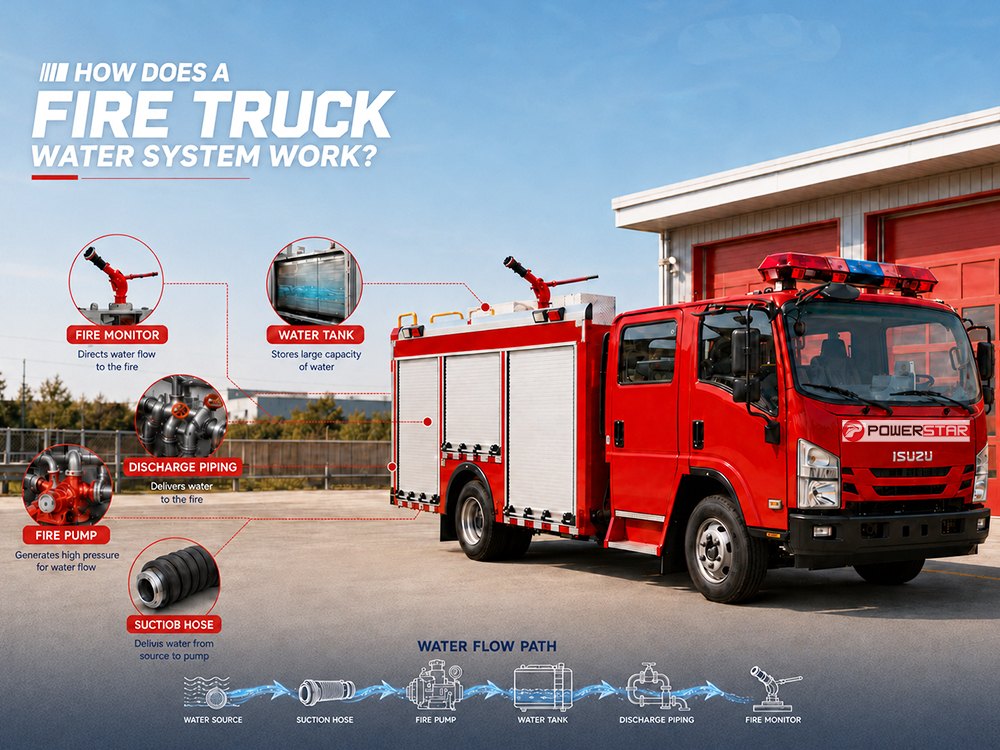
Le système de plomberie hydraulique d’un camion de pompiers est le cœur de chaque opération de lutte contre l’incendie. Il dirige avec précision l’eau depuis le réservoir ou une source externe à travers la pompe, les vannes et les tuyauteries afin de fournir de l’eau ou de la mousse à haute pression sur le lieu de l’incendie — qu’il s’agisse d’un feu dans un immeuble de grande hauteur au cœur d’une ville densément peuplée ou d’un incendie de réservoir de stockage pétrochimique dans une zone industrielle. Le camion de pompiers système de plomberie hydraulique se compose de plusieurs composants fonctionnant ensemble : pompe incendie, réservoir d’eau, tuyau d’aspiration, tuyauterie de refoulement, vannes, collecteur de division, collecteur de rassemblement, crépine, canon incendie, raccords de tuyaux, et plus encore. Le parcours complet du flux est : Réservoir d’eau → Tuyau d’aspiration → Crépine → Pompe incendie → Système de régulation de pression → Collecteur de refoulement → Vannes → Collecteur de division → Canon incendie / Raccords de tuyaux → Buse Cet article explique chaque composant du système de plomberie hydraulique et comment ils fonctionnent ensemble pour fournir de l’eau à la pression et au débit appropriés. I. Composants principaux du système de plomberie hydraulique Réservoir d’eau Stocke l’approvisionnement en eau embarqué. ● Capacité : Généralement 2 000 à 12 000 litres. ● Alimentation : Fournit de l’eau à la pompe par la tuyauterie d’admission. ● Caractéristiques : Cloisons anti-ballottement pour la stabilité du véhicule, crépine pour filtrer les débris et système d’amorçage pour l’aspiration depuis des sources d’eau naturelles. Pompe incendie Une pompe centrifuge entraînée par le moteur du camion via une prise de force (PTO) ; à un ou plusieurs étages, en fonte ou en bronze. ● Classes de pression: Disponibles avec des valeurs nominales standard de 0,8 MPa, 1,0 MPa, 1,2 MPa et 1,4 MPa, adaptées aux exigences courantes de la lutte contre l’incendie. ● Débits: De 1 200 à 6 000 L/min, avec des courbes de performance optimisées pour les opérations à haute pression comme pour celles nécessitant un grand volume d’eau. Vannes et tuyauteries Un réseau de tuyaux et de vannes qui contrôle la direction et le volume du débit d’eau. ● Vanne d’admission: Relie la pompe aux sources d’eau externes (borne d’incendie ou point d’aspiration) ● Vanne réservoir-pompe: Permet à la pompe de puiser directement l’eau du réservoir embarqué ● Vannes de refoulement: Contrôlent le débit d’eau vers les tuyaux et les buses II. Fonctionnement du système de plomberie hydraulique d’un camion de pompiers Étape 1 : Prise d’eau et amorçage L’eau entre dans le système depuis le réservoir embarqué, une borne d’incendie ou des sources d’eau naturelles (lacs, rivières, étangs). Lors d’une aspiration depuis des sources naturelles, le système d’amorçage (pompe à vide) élimine l’air du tuyau d’aspiration, créant un vide qui permet à la pression atmosphérique de pousser l’eau...
Détails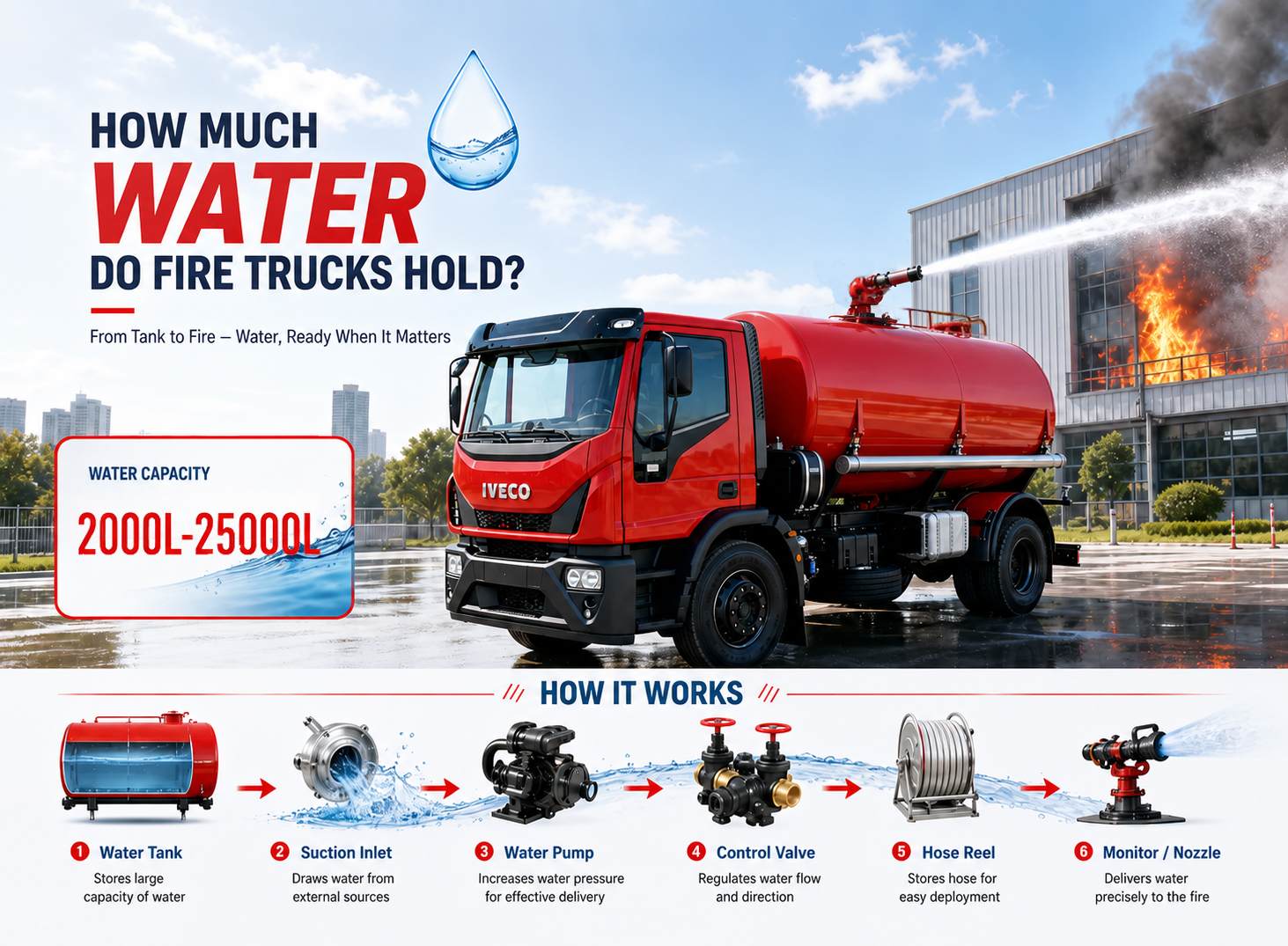
Quelle quantité d’eau un camion de pompiers peut-il transporter ? C’est l’une des premières questions auxquelles nos clients sont confrontés lorsqu’ils choisissent un camion de pompiers. Il n’existe pas de nombre fixe unique : cela dépend du type de véhicule, de la capacité du châssis, de la conception prévue et des réglementations régionales, allant des unités légères de 2 000 litres aux camions de pompiers industriels de 25 000 litres. Cependant, un réservoir plus grand ne signifie pas toujours de meilleures performances ;véhicule de lutte contre l’incendie la capacité du réservoir d’eau doit être correctement adaptée au débit de la pompe, au débit de décharge du canon et à la capacité du châssis afin d’obtenir des résultats efficaces de lutte contre l’incendie. Cet article commence par les principes fondamentaux de la capacité des réservoirs d’eau des camions de pompiers, analyse les plages de stockage typiques pour différents types de véhicules, examine les principaux facteurs qui influencent la conception des réservoirs et fournit des conseils pratiques pour l’achat. Points clés à retenir : La capacité du réservoir d’eau d’un camion de pompiers varie généralement de 2 000 à 25 000 litres Les différents types de camions de pompiers ont des capacités de réservoir différentes Un réservoir plus grand ne signifie pas une meilleure capacité de lutte contre l’incendie La capacité du réservoir doit être adaptée au débit de la pompe, au débit du canon et à la capacité du châssis La lutte contre les incendies industriels nécessite généralement de grands réservoirs, tandis que la lutte contre les incendies municipaux privilégie la maniabilité » I. Trois types de base de réservoirs d’eau pour camions de pompiers Camions d’intervention avec pompe :Ce sont les camions de pompiers municipaux les plus courants. Ils dépendent principalement des bornes d’incendie pour l’approvisionnement en eau et transportent environ 1 900 à 3 800 litres d’eau embarquée pour l’attaque initiale. Le cœur de ces véhicules est la pompe, et non le réservoir : ils sont conçus pour fournir de l’eau sous pression une fois raccordés à une borne d’incendie. Camions-citernes (ravitailleurs en eau) :Ces véhicules sont dédiés au transport de grands volumes d’eau, avec des capacités de réservoir dépassant généralement 11 400 litres. Ils jouent un rôle essentiel dans les zones rurales et isolées où les bornes d’incendie ne sont pas disponibles, en transportant l’eau des sources d’approvisionnement jusqu’au lieu de l’incendie pour que les camions-pompes puissent l’utiliser. Camions pompe-citerne :Ces véhicules combinent les fonctions de pompage et de transport d’eau en une seule unité. Ils peuvent à la fois projeter de l’eau pour la lutte contre l’incendie et approvisionner d’autres véhicules. Les capacités de réservoir varient généralement de 5 700 à 11 400 litres, ce qui en fait une solution polyvalente pour les services d’incendie. » II. Quelle quantité d’eau les différents types de cami...
Détails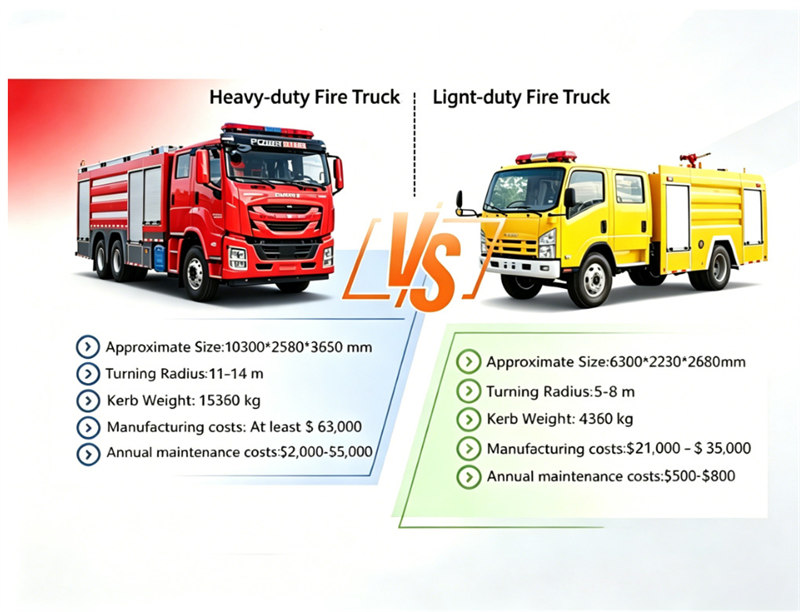
Camion de secours incendieLes besoins varient considérablement entre les zones métropolitaines et les communautés rurales ou les petites villes. Les grands services d’incendie urbains s’appuient sur des camions de pompiers lourds dotés de réservoirs d’eau massifs, d’échelles pour immeubles de grande hauteur et de configurations industrielles complètes pour gérer les incendies dans les gratte-ciel, les incendies industriels et les urgences de grande ampleur. Cependant, pour les petites villes, les communes rurales, les casernes de pompiers de village et les services d’incendie volontaires, les camions de pompiers lourds deviennent souvent davantage une charge qu’un avantage. C’est pourquoi les camions de pompiers légers sont devenus la solution la plus courante et la plus pratique pour les services d’incendie des petites villes et des zones rurales dans le monde entier. En équilibrant une taille compacte, une mobilité flexible, des fonctions de secours de base complètes et des coûts globaux réduits, ils répondent parfaitement aux besoins quotidiens de secours et de prévention des incendies des équipes de pompiers locales. Le camion de pompiers léger est un véhicule d’urgence compact et léger conçu spécifiquement pour les interventions incendie en zones locales, suburbaines et rurales. I. Comparaison entre les camions de pompiers lourds et les camions de pompiers légers : Pour clairement voirl’écart entre les camions de pompiers lourds et légers, nous avons préparé un tableau comparatif direct couvrant les principaux indicateurs pratiques. Les modèles lourds dépassent 10 mètres de longueur avec un rayon de braquage de 11 à 14 m et un poids à vide de 15 tonnes, coûtant au moins 63 000 $ à construire, auxquels s’ajoutent 2 000 à 5 000 $ d’entretien annuel. En revanche, les camions de pompiers légers compacts réduisent presque de moitié les dimensions, ne pèsent que 4 360 kg, commencent à 21 000 $ et maintiennent les coûts d’entretien annuel sous les 800 $, offrant une bien meilleure mobilité et un meilleur rapport coût-efficacité pour les casernes rurales et des petites villes. Ⅱ.Points forts des camions de pompiers légers : 1. Conception légère avec une capacité de charge élevée. Le poids total en charge du véhicule reste inférieur à 8 000 kg même lorsqu’il est entièrement chargé, permettant une intervention d’urgence ultra-rapide. 2. La personnalisation avec transmission intégrale est disponible pour affronter les surfaces routières difficiles et irrégulières courantes dans les régions isolées. 3. Toutes les fonctionnalités essentielles de lutte contre les incendies sont entièrement conservées : a. Deux réservoirs indépendants pour l’eau et la mousse d’extinction des incendies. b. Cabine d’équipage à double rangée permettant d’accueillir une équipe complète de pompiers intervenants. c. Inventaire standard complet d’outils de secours et de lutte contre les incendies. d. Options supplémentaires comprenant des systèmes d’éclairage de...
Détails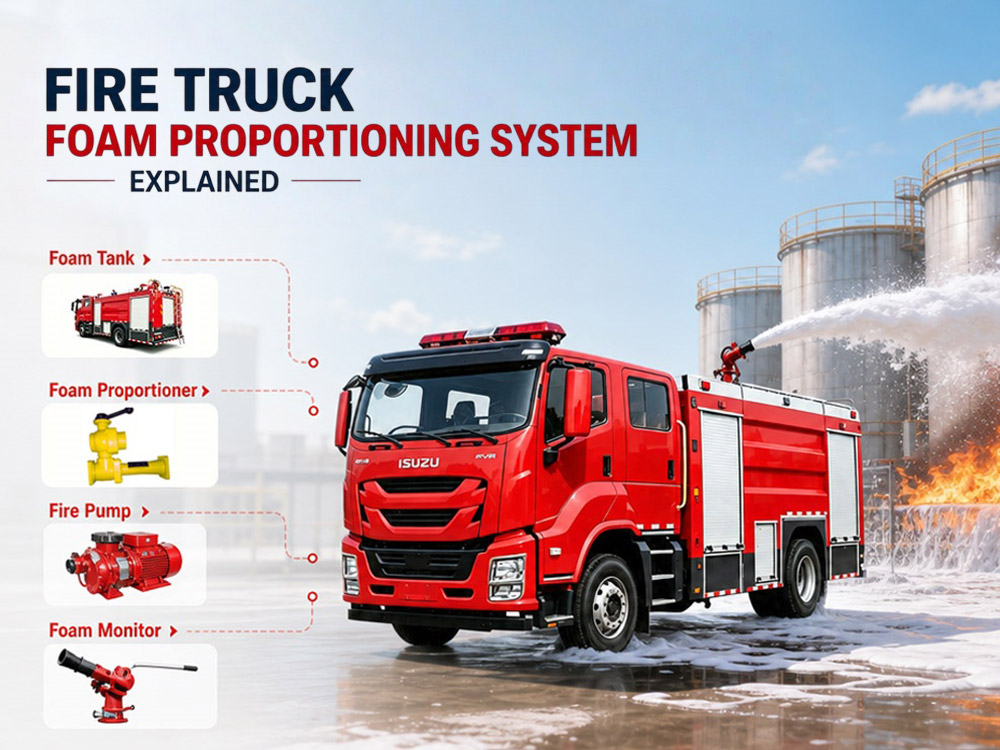
Le système de mousse d'un camion de pompiers mélange l'eau avec du concentré de mousse selon des proportions précises (1 %, 3 % ou 6 %) afin de créer une solution moussante. Cette solution est ensuite mise sous pression par la pompe incendie et expansée avec de l'air à travers des buses à mousse — c'est le principe de fonctionnement fondamental de la manière dont un camion incendie à mousse mélange la mousse et l'eau — produisant finalement une couverture de mousse stable qui recouvre la surface du combustible. Ce processus augmente l'efficacité de la lutte contre l'incendie de plus de 50 % tout en réduisant le gaspillage de concentré de mousse de 30 %. » I. Pourquoi un camion de pompiers a-t-il besoin d'un système de mousse ? Comparée à l'utilisation de l'eau seule, la mousse offre trois avantages clés : 1. Isolation de l'oxygène— La mousse recouvre la surface en combustion, formant une barrière physique dense qui empêche l'oxygène d'atteindre la zone de combustion, supprimant ainsi l'incendie. 2. Réduction de la température— La teneur en eau de la solution moussante absorbe de grandes quantités de chaleur lors de son évaporation, réduisant rapidement la température de la zone en combustion. 3. Prévention de la reprise d'incendie— La couche de mousse continue de couvrir la zone incendiée même après l'extinction, isolant efficacement l'oxygène et les vapeurs inflammables, ce qui réduit considérablement le risque de reprise d'incendie. » II. Principes de fonctionnement fondamentaux du système de mousse 1. Système de dosage :L'eau circule à travers le doseur → crée une pression négative (système à pression négative) ou utilise une pompe à mousse (système à pression positive) → aspire le concentré de mousse depuis le réservoir de mousse → mélange selon le taux prédéfini (1 %, 3 % ou 6 %) → la solution moussante s'écoule vers la pompe. 2. Mise sous pression par la pompe :La solution moussante entre dans la pompe centrifuge → est mise sous pression à 0,8–1,2 MPa → est acheminée par des conduites vers les sorties de refoulement ou le canon à mousse. 3. Expansion de la mousse :La solution moussante sous pression passe par une buse à mousse ou un dispositif d'aération → l'air est entraîné → la solution se transforme en mousse finie → recouvre la surface du combustible → coupe l'arrivée d'oxygène et éteint l'incendie. Concept clé :Le concentré de mousse + l'eau ne produisent pas directement une mousse finie. La solution moussante mélangée est encore un liquide — elle doit être combinée avec de l'air à travers une buse à mousse pour devenir une véritable mousse d'extinction. Lorsque la solution moussante haute pression traverse la buse à grande vitesse, elle crée une zone locale de pression négative qui aspire l'air de force. L'air et le liquide entrent en collision et sont violemment cisaillés à l'intérieur de la buse, se décomposant instantanément en millions de petites bulles qui s'accumulent pour former une mousse blanche. » III. Comment un camion de p...
Détails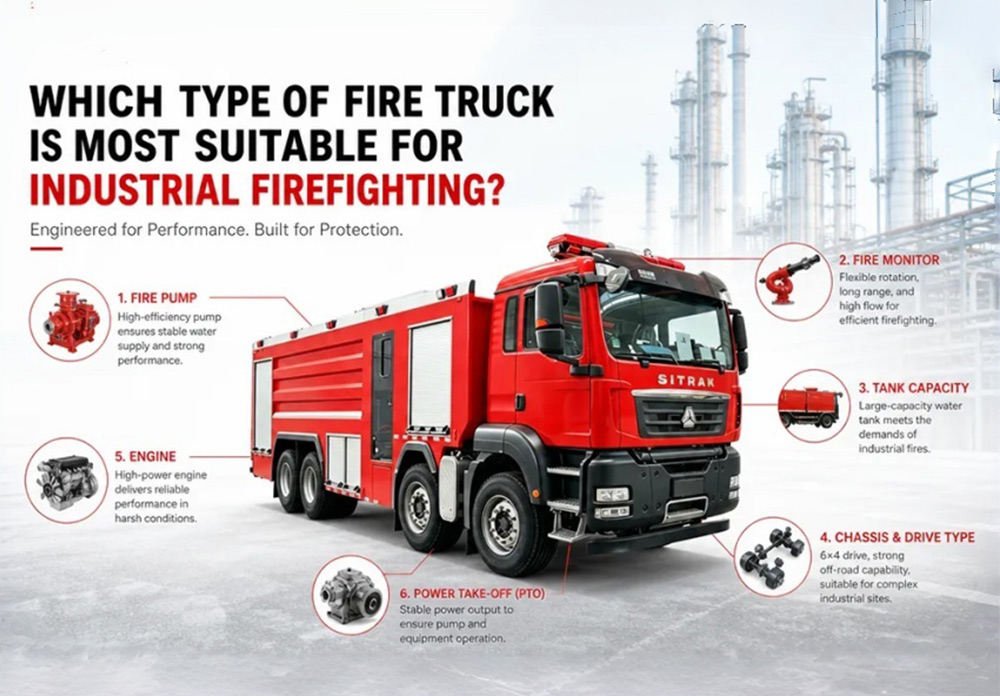
Les incendies industriels sont fondamentalement différents des incendies structurels ordinaires. Les usines pétrochimiques sont principalement confrontées à des incendies de liquides inflammables et de gaz combustibles, tandis que les installations de fabrication et les centres logistiques d'entreposage traitent plus souvent des matériaux combustibles ordinaires — c'est pourquoi différents types de camions de pompiers industriels sont nécessaires pour différents risques d'incendie. Cet article compare les camions-citernes d'incendie à eau, les camions d'incendie à mousse, les camions d'incendie à poudre sèche et les unités combinées. Ce guide d'achat complet aide les responsables des achats, les ingénieurs, les distributeurs et les entrepreneurs à comprendre les principales différences entre les types de camions de pompiers industriels et à sélectionner le véhicule le plus adapté à leurs besoins spécifiques de lutte contre les incendies industriels. » I. Réponse rapide : quel camion de pompiers est le meilleur pour la lutte contre les incendies industriels ? La sélection doit être basée sur le type d'incendie, les caractéristiques de l'industrie et les exigences en matière d'extinction : Industrie Camion de pompiers recommandé Raison Pétrochimie Unité combinée eau + mousse + poudre sèche Couvre les incendies de classes A, B, C et les incendies électriques ; s'adapte aux scénarios d'incendie complexes Gaz naturel / GNL Camion d'incendie à poudre sèche Extinction rapide des incendies de gaz ; réduit le risque de reprise du feu Fabrication générale Camion d'incendie à eau Coût inférieur ; adapté aux incendies de classe A ; entretien simple Entreposage et logistique Camion d'incendie à mousse Peut traiter à la fois les combustibles ordinaires et certains incendies de liquides Centrale électrique Camion d'incendie à poudre sèche + mousse Répond aux besoins de suppression des incendies d'équipements électriques et d'hydrocarbures Exploitation minière Camion d'incendie à eau 6x4 Grande capacité de charge ; bonne aptitude au tout-terrain ; adapté aux terrains difficiles En termes simples : Installations industrielles générales : un camion d'incendie à eau est généralement suffisant. Industries pétrolières et chimiques : un camion d'incendie à mousse est le premier choix. Industries spéciales (gaz naturel, équipements électriques) : un camion d'incendie à poudre sèche est recommandé. Grands parcs industriels intégrés : une unité combinée eau + mousse + poudre sèche offre la capacité de lutte contre l'incendie la plus complète et constitue le choix le plus polyvalent. » II. Comprendre les risques d'incendie industriels Avant de sélectionner un camion de pompiers, les acheteurs doivent comprendre les dangers d'incendie présents dans leur installation. Les incendies industriels sont classés selon le type de combustible impliqué. Classifications des incendies dans les environnements industriels Classe d'incendie Type de combustible Exemples Agent extincte...
Détails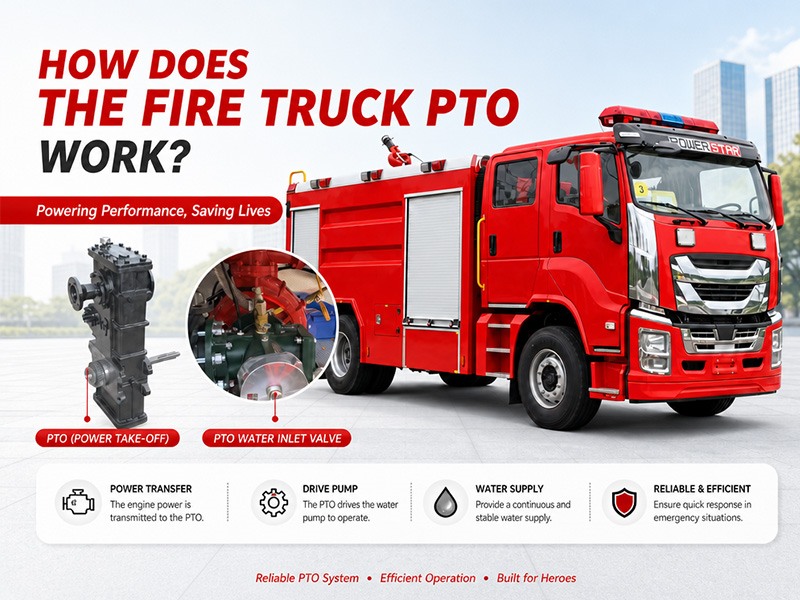
La prise de force (PTO, Power Take-Off) d'un camion de pompiers est un dispositif de transmission de puissance qui transfère la puissance du moteur vers la pompe incendie. Lorsque le pompier active la PTO, la puissance mécanique du moteur est transmise à travers la boîte de vitesses et la PTO jusqu'à la pompe incendie — c'est le principe de fonctionnement central de la manière dont un camion de lutte contre l'incendie fonctionne avec un système PTO — permettant à la pompe de fournir de l'eau ou de la mousse à haute pression et à haut débit sans avoir besoin d'un moteur auxiliaire séparé. Les camions de pompiers modernes utilisent généralement des systèmes PTO montés latéralement ou des systèmes PTO à pleine puissance. Ceux-ci offrent une sortie de puissance stable, une utilisation pratique et de faibles coûts de maintenance, ce qui en fait un composant essentiel du système de lutte contre l'incendie du camion de pompiers. » I. Qu'est-ce qu'une PTO de camion de pompiers ? 1. Définition de la PTO La PTO (Power Take-Off) est un composant essentiel du système d'alimentation du camion de pompiers. Il s'agit d'un dispositif de transmission par engrenages installé entre le moteur et la boîte de vitesses, conçu pour « détourner » une partie de la puissance mécanique du moteur ou de la transmission du véhicule vers la pompe incendie ou d'autres équipements auxiliaires, sans affecter la capacité de conduite normale du véhicule. Le moteur du camion de pompiers est à l'origine uniquement chargé d'entraîner les roues. Cependant, une fois que le camion de pompiers arrive sur le lieu de l'incendie, les roues n'ont plus besoin de puissance, tandis que la pompe incendie nécessite de l'énergie pour aspirer et mettre l'eau sous pression. La PTO est le dispositif qui réalise ce « commutateur de puissance ». 2. Que signifie Power Take-Off ? Power Take-Off (PTO) signifie littéralement « dispositif de sortie de puissance ». Sur un camion de pompiers, cela désigne l'extraction de la puissance de rotation du volant moteur ou des engrenages de la transmission par engagement des engrenages, puis sa transmission vers la pompe incendie ou d'autres équipements auxiliaires. Son nom décrit sa fonction : Moteur = Source de puissance PTO = Distributeur de puissance Pompe incendie = Extrémité de consommation de puissance Par conséquent, la PTO est le pont reliant la « source de puissance » et le « système de lutte contre l'incendie ». » II. Pourquoi un camion de pompiers a-t-il besoin d'une PTO ? La raison principale pour laquelle les camions de pompiers doivent être équipés d'une PTO est que les opérations de lutte contre l'incendie nécessitent une sortie de puissance continue, stable et élevée qui ne peut pas dépendre de l'état de conduite du véhicule. Raisons principales : 1. Fournit une puissance continue pour la lutte contre l'incendie La pompe incendie doit fonctionner pendant de longues périodes lors des opérations de lutte contre l'incendie. La PTO permet au moteur d'entra...
Détails
Veuillez lire la suite, restez informés, abonnez-vous, et n'hésitez pas à nous faire part de vos commentaires.

 Network IPv6 pris en charge

 français
 English
 Deutsch
 русский
 italiano
 español
 português
 Nederlands
 العربية
 日本語
日本語 한국의
한국의 Türkçe
 Melayu
 ไทย
ไทย Tiếng Việt
 Indonesia
  中文
中文 қазақ
қазақ Filipino
 မြန်မာ
 српски